
TL;DR
Most indoor plants don’t die from watering—they die from wrong light
Your “bright room” is probably too dark
1–2 meters from a window can slowly kill your plant
Wrong light → wrong watering → root rot
Fix light first… or nothing else will work
The Brutal Truth: It’s Probably NOT Your Watering
If your plant:
- isn’t growing
- looks weak
- leans toward one side
- or just “stays alive” without improving
the problem is most likely light, not watering.
Without proper light, the plant can’t use water efficiently and weakens over time.
It looks like a watering issue—but it’s not.
If you want the full breakdown of all the real causes, read: Why Indoor Plants Die (And How to Prevent It)
What “Light” Actually Means (No One Explains This Properly)
When people say “this plant needs light,” they’re oversimplifying.
Light has 3 different components:
1. Intensity (how strong the light is)
- Direct sunlight through a window = high intensity
- A bright room = often low intensity
Your eyes adjust. Plants don’t.
2. Duration (how long the plant gets light)
- 2 hours of direct sun ≠ 8 hours of indirect light
- Plants need enough time to generate energy
3. Distance from the window (the invisible killer)
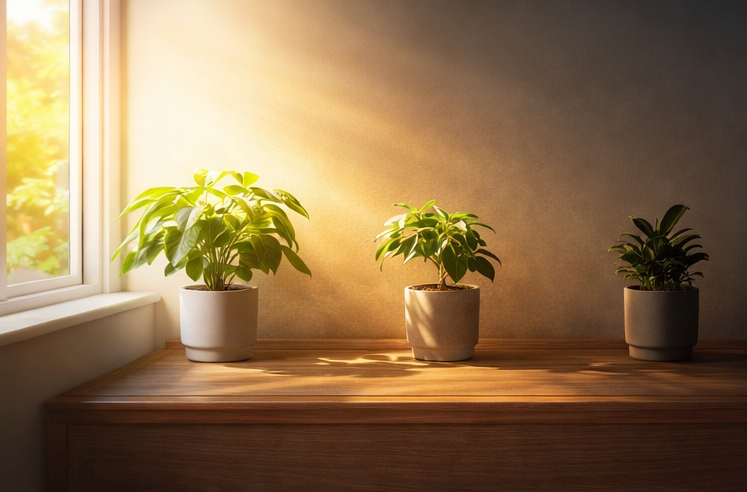
- 30 cm from a window → strong usable light
- 2 meters away → dramatically weaker light
Even if the room looks “bright.”
Every step away from the window reduces light exponentially.
The Biggest Myth: “Low Light Plants”
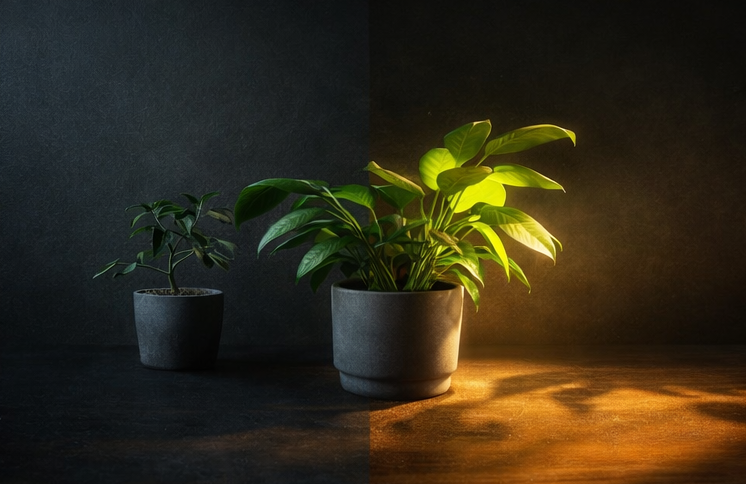
There’s no such thing as a plant that loves low light.
There are only plants that can tolerate surviving in it.
Examples:
- Snake plant (see: How to Care for Snake Plant Indoors)
- ZZ plant (see: ZZ Plant Care – Beginner Guide)
- Pothos (see: Pothos Plant Care Indoors – Beginner Guide That Actually Works)
But in low light:
- growth slows down
- structure weakens
- leaves become smaller or stretched
They’re not thriving—they’re surviving.
They’re not thriving—they’re surviving.
If your space is truly low light, here are the only indoor plants that can actually survive those conditions.
How to Know If Your Plant Is Getting the WRONG Light
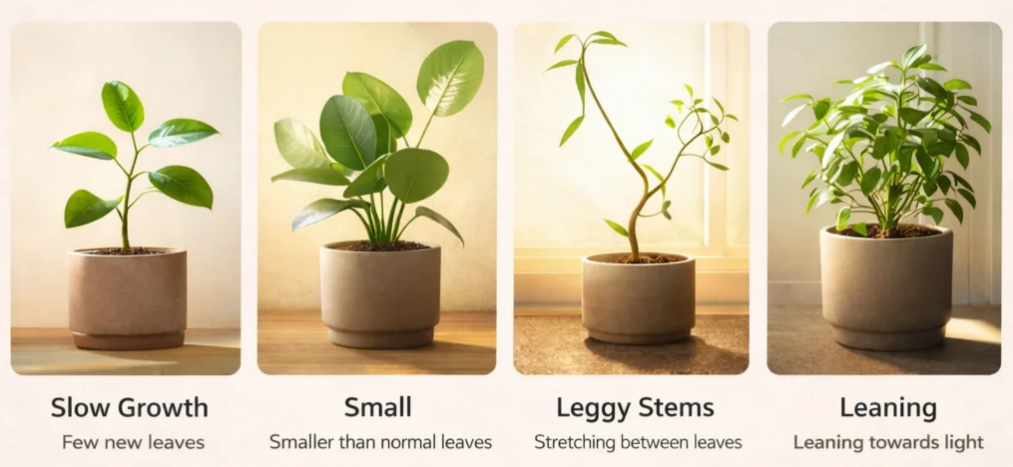
Too Little Light (most common problem)
Clear signs:
- slow or no growth
👉 If your plant isn’t growing even in a “bright” room, your light is probably weaker than you think:
Why your indoor plant is not growing (and what it’s trying to tell you) - small or weak leaves
- long, stretched stems (leggy growth)
- plant leaning toward the window
- dull or pale color
If leaves are turning yellow, read: Yellow Leaves on Indoor Plants (Causes and How to Fix Them)
Translation:
Your plant is desperately searching for light.
Too Much Light (less common, but real)
Signs:
- burned patches (brown or white spots)
- crispy edges
Not all brown or crispy edges mean the same thing — learn how to diagnose the exact cause here:
👉 Brown Leaves on Indoor Plants (Causes & Fixes) - faded or bleached leaves
- dry, brittle texture
Translation:
Too much direct sun, especially through glass.
The Only Placement Guide You Actually Need
Forget confusing labels. Use this:
Bright Direct Light
- Several hours of direct sun
- Example: north-facing window (southern hemisphere)
Best for:
- sun-loving plants
- faster growth
Bright Indirect Light (THE SWEET SPOT)
- very bright, but no harsh direct sun
- near a window, possibly filtered
Best for:
- most indoor plants
Low Light
- far from windows
- ambient room light
Only good for:
- survival, not growth
The 1-Second Test (Stop Guessing)
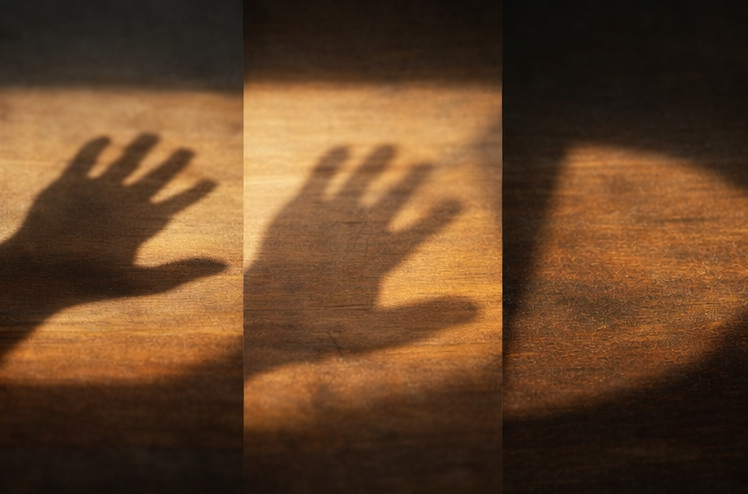
Stand where your plant is and look at your hand:
- sharp, defined shadow → strong light
- soft shadow → medium light
- no shadow → low light
Why Your Plant Looks “Fine”… But Isn’t
Light problems don’t kill plants quickly.
They degrade slowly.
So you think:
- “It’s still alive”
- “It’s not getting worse”
But:
- it’s not growing
- it’s not improving
- it’s stuck in survival mode
That’s not healthy—that’s stagnation.
👉 If your plant has been declining for a while, here’s how to save a dying plant before it’s too late.
👉 If your plant shows multiple symptoms, see: Indoor Plant Problems (Common Issues & How to Fix Them Fast)
Light Changes Everything (Including Watering)
This is the connection most people miss:
More light → plant uses more water
Less light → plant uses less water
If light is wrong, your “correct” watering becomes incorrect.
If you’re unsure about watering, start here: Indoor Plant Watering Guide (Stop Killing Your Plants With Kindness)
That’s why:
- overwatering in low light is extremely common
Learn to recognize it early: Overwatering Indoor Plants (Signs, Causes, and How to Fix It) - root rot is often a light problem in disguise
Not sure if you’re doing the opposite? Check: Underwatering Indoor Plants (Signs, Fixes & How to Save a Dying Plant)
How to Fix Light Problems (Fast)
If you’re choosing plants based on your space, start here: Best Indoor Plants for Beginners
1. Move the plant closer to a window
This alone fixes most cases.
👉 If you’re not sure where that “better spot” actually is in your space, read:
Better Ways to Place Indoor Plants (Where to Place Plants So They Actually Thrive, Not Just Look Good)
2. Rotate the plant weekly
Prevents uneven growth.
3. Use curtains if sunlight is too harsh
Filter light—don’t remove it completely.
4. Stop trusting how the room “looks”
Trust:
distance + shadow + plant signals
The Real Shift: Stop Thinking “Decoration”… Start Thinking “Energy”
A plant is not decoration.
It’s a living system that runs on light.
If light is wrong:
everything else breaks.
👉 Want to see how this actually translates into a real space?
Empty Corner to Plant Corner (Before & After Ideas)
Before You Blame Anything Else…
If your plant is struggling:
don’t start with watering
don’t start with fertilizer
Start here:
Is the light actually correct?
In most cases, it is.
Final Takeaway
- Light controls everything
- Most people misjudge it completely
- “Low light” is misleading
- Distance from the window is critical
Fix the light, and often:
- growth returns
- problems disappear
- the plant recovers naturally
If you’re starting from scratch, read: How to Care for Indoor Plants (Beginner Guide)