
TL;DR
Most indoor plants don’t die suddenly — they slowly dry out.
If your plant looks dull, crispy, or lifeless, it may not be dying… it’s dehydrated.
Water deeply, not frequently — and always check the soil first.
Think Your Plant Is Dying? It Might Just Be Thirsty
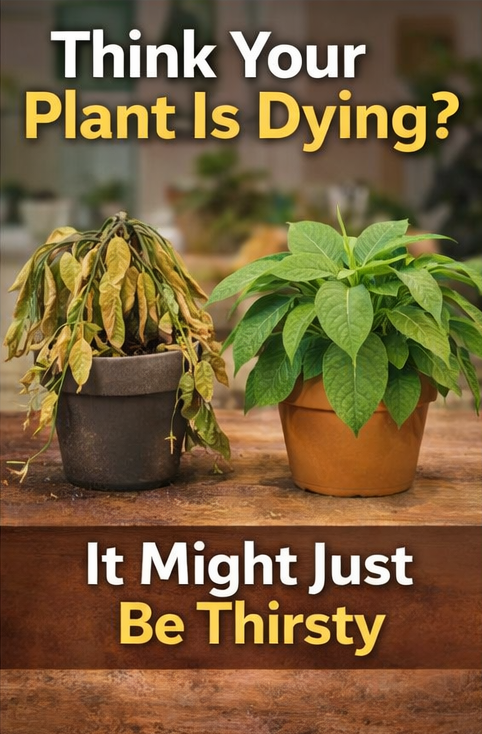
Most beginners assume the worst.
Yellow leaf? Dead plant.
Drooping leaves? Disease.
Brown edges? Time to throw it away.
But here’s the truth:
Many plants that look “dead” are actually severely underwatered — and completely recoverable.
Underwatering is sneaky.
It doesn’t rot your plant overnight like overwatering…
It slowly drains the life out of it.
And by the time you notice, the damage looks irreversible.
👉 The good news: even severely dehydrated plants can recover — if you act early and follow the right steps
Not sure if it’s underwatering or something else?
Start with the complete watering guide: Indoor Plant Watering Guide.
What Happens When You Don’t Water Enough
Plants rely on water for structure, nutrient transport, and survival.
When they don’t get enough:
- Cells lose pressure → leaves droop
- Nutrients stop moving → growth slows
- Tips dry out → leaves turn brown and crispy
If it continues:
- The plant enters survival mode
- Growth stops completely
- Leaves die off to conserve energy
Unlike overwatering, this is a slow decline — which is why many people miss it.
Clear Signs of Underwatering (Don’t Ignore These)
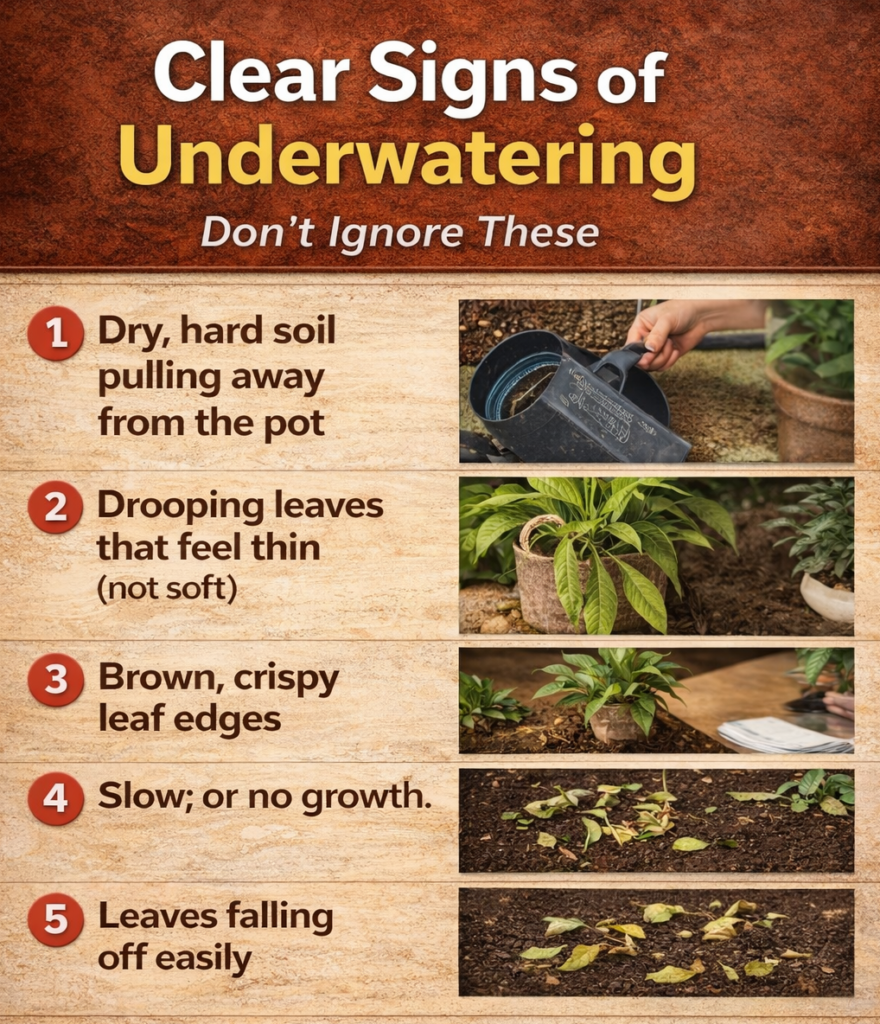
Before jumping into fixes, you need to be sure what you’re dealing with.
Many plant owners misread the signs — and end up making the problem worse.
Here’s how to clearly identify if your plant is underwatered.
How to confirm it’s really underwatering (Without Guessing)
These are the most common signs of an underwatered plant:
- Dry, hard soil pulling away from the pot
The soil shrinks and separates from the edges.
This is one of the earliest and most reliable signs. - Drooping leaves that feel thin (not soft)
Leaves lose structure and look weak.
Key detail: they feel light and papery, not heavy or mushy.
Peace lilies are one of the best examples of this behavior — they droop dramatically when dry but recover quickly after proper watering.
👉 See the full care guide: Peace Lily Care Indoors (Beginner Guide That Actually Works) - Brown, crispy leaf edges
The tips or edges dry out and turn brown.
This usually means the plant has been dry for a while, not just recently.
Not all dry-looking leaves mean underwatering — learn how to tell the difference here:
👉 Brown Leaves on Indoor Plants (Causes & Fixes)
👉 Not all brown leaves mean the same thing — here’s what’s actually causing them (and how to fix it) - Slow or no growth
The plant looks “stuck” and stops producing new leaves.
Growth pauses because the plant is conserving resources. - Leaves falling off easily
Leaves drop with minimal touch.
This is a stress response — the plant is trying to survive.
How to interpret these signs
Each of these signs is a valid indicator on its own.
But the more you see at the same time, the more certain the diagnosis:
- 1 sign → possible underwatering
- 2–3 signs → very likely
- 4–5 signs → severe or prolonged stress
Important: These signs don’t always appear in order
You might see:
- Dry soil first
- Or drooping leaves before anything else
- Or leaf drop in more advanced cases
It depends on how long the plant has been underwatered and the environment.
The most common mistake
Drooping leaves can be confusing.
Here’s how to confirm it’s underwatering:
- Underwatering → leaves feel thin, light, slightly dry
- Overwatering → leaves feel soft, heavy, sometimes mushy
Before assuming underwatering, check if light is the real issue: Indoor Plant Light Requirements (Complete Guide That Actually Makes Sense)
The Biggest Underwatering Mistake (That Makes It Worse)
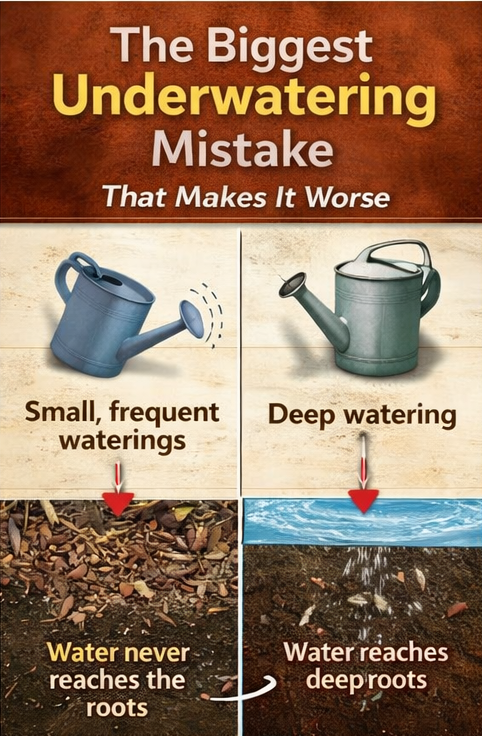
Most people try to “fix” underwatering like this:
They give a small amount of water more often
This is wrong.
Why?
Because:
- Water never reaches the roots
- Only the top layer gets wet
- Roots stay dry → problem continues
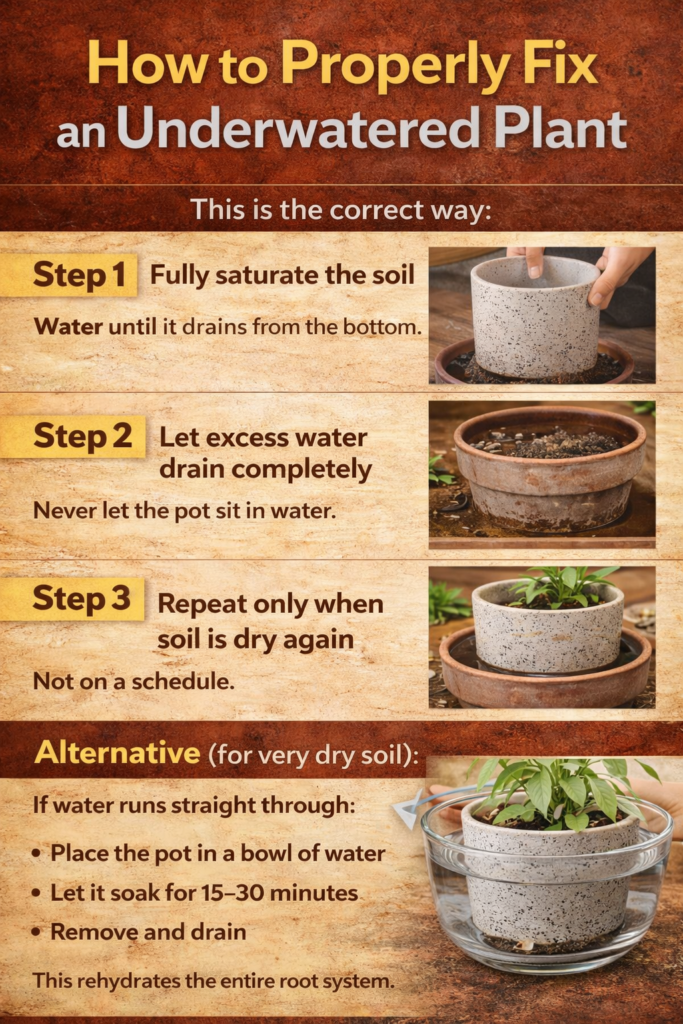
How to Properly Fix an Underwatered Plant
Most people think fixing an underwatered plant is simple:
“Just water it.”
But if you do it wrong, you can:
- Stress the roots
- Cause uneven hydration
- Or even shock the plant
Step 1: Fully saturate the soil
This is the most important step — and where most people fail.
You need to completely rehydrate the root zone
Water slowly until you see water draining from the bottom.
Why this matters:
- Dry soil becomes hydrophobic (repels water)
- If you water too fast, water runs through → roots stay dry
💡 Pro tip:
Water in 2–3 passes, not all at once.
Step 2: Let excess water drain completely
After watering:
Let the pot drain fully — no exceptions.
If the plant sits in water:
- Roots lose oxygen
- You create conditions for root rot
This is how people turn underwatering into overwatering damage.
Step 3: Repeat only when soil is dry again
This is where most people overcorrect.
They start watering too often.
Don’t.
Wait until the soil is dry again before repeating.
Why:
- Roots need oxygen cycles
- Constant moisture weakens the plant
Alternative Method (for severely dry soil)
If water runs straight through the pot:
Your soil is too dry to absorb water properly.
Use this method:
- Place the pot in a bowl of water
- Let it soak for 15–30 minutes
- Remove and let it drain
This allows water to enter from the bottom up, fully rehydrating the soil.
How Fast Will Your Plant Recover?
Depends on severity:
- Mild → 24–48 hours (leaves perk up)
- Moderate → a few days
- Severe → some leaves won’t recover
Important:
Dead leaves won’t come back — look for new growth instead.
How Often Should You Water? (The Truth)
There is no fixed schedule.
Not weekly. Not every 3 days. Not “every Sunday”.
The ONLY rule that works:
Water when the soil is dry.
That’s it.
Factors that change everything:
- Light (more light = more water needed)
- Temperature
- Pot size
- Soil type
This is why schedules fail.
👉 If you want to avoid both underwatering and overwatering completely, read the full indoor plant watering guide.
Underwatering vs Overwatering (Don’t Confuse Them)
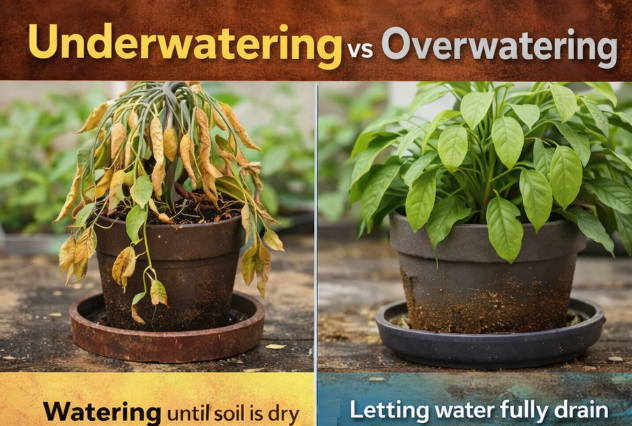
This is critical.
Both can cause drooping leaves.
Underwatering:
- Leaves feel dry, thin, crispy
- Soil is completely dry
Overwatering:
- Leaves feel soft, mushy
- Soil is wet
If you misdiagnose this, you’ll make it worse.
How to Prevent Underwatering (Simple System)
Use this routine:
- Stick your finger 2–3 cm into the soil
- If dry → water
- If moist → wait
That’s your system.
No apps. No schedules. No guessing.
Final Tip: Water Deeply, Then Do Nothing
This is where most people fail.
They overcomplicate it.
But healthy plants follow a simple cycle:
Deep watering → full drying → repeat
Not:
Constant small watering
Daily checking and reacting
Panic watering
Want to Stop Guessing When to Water?
If you’re still unsure whether your plant needs water, check this guide:
👉 How to Tell If Your Plant Needs Water
(It will save you from both underwatering and overwatering.)