
An indoor plant divider can do more than simply separate two areas. The right setup can create privacy, define different functions within an open-plan room, add storage, or introduce greenery without closing the space off completely.
But not all plant dividers work the same way. Some rely on a solid planter, others use shelving or a trellis, while mobile and modular designs offer more flexibility. Hanging solutions can separate spaces without taking up much floor area, while angled and curved structures use the geometry of the divider itself to shape the room.
Below, these 11 indoor plant divider ideas are organized by their physical structure and how they create separation. Each solution has a distinct construction, so you can compare the level of privacy, openness, flexibility, space efficiency, setup, plant capacity, maintenance, and overall accessibility before deciding which approach fits your space.
Quick Comparison: 11 Indoor Plant Divider Ideas
| Solution | Privacy | Light | Flex. | Space | Setup | Plants | Upkeep | Afford. |
|---|---|---|---|---|---|---|---|---|
| Slatted Screen + Integrated Planter | 4/5 | 4/5 | 3/5 | 3/5 | 3/5 | 4/5 | 3/5 | 3/5 |
| Plant-Filled Open Shelving Divider | 3/5 | 4/5 | 3/5 | 4/5 | 3/5 | 5/5 | 3/5 | 3/5 |
| Trellis + Climbing Plants | 4/5 | 4/5 | 3/5 | 4/5 | 4/5 | 4/5 | 3/5 | 3/5 |
| Rolling / Mobile Plant Divider | 3/5 | 4/5 | 5/5 | 3/5 | 3/5 | 4/5 | 3/5 | 3/5 |
| Freestanding Metal Frame + Hanging Plants | 3/5 | 4/5 | 4/5 | 4/5 | 4/5 | 4/5 | 3/5 | 4/5 |
| Long Planter Box + Tall Plants | 4/5 | 3/5 | 2/5 | 2/5 | 3/5 | 5/5 | 3/5 | 2/5 |
| Hanging Plant Curtain | 3/5 | 4/5 | 2/5 | 4/5 | 3/5 | 4/5 | 2/5 | 4/5 |
| Partial-Height Plant Partition | 3/5 | 5/5 | 3/5 | 3/5 | 3/5 | 4/5 | 4/5 | 3/5 |
| Modular Plant Partition | 4/5 | 4/5 | 5/5 | 3/5 | 3/5 | 5/5 | 3/5 | 3/5 |
| Angled Plant Divider | 4/5 | 3/5 | 3/5 | 2/5 | 2/5 | 4/5 | 3/5 | 2/5 |
| Curved Plant Room Divider | 4/5 | 3/5 | 2/5 | 2/5 | 2/5 | 4/5 | 3/5 | 1/5 |
Slatted Screen + Integrated Planter
What It Is
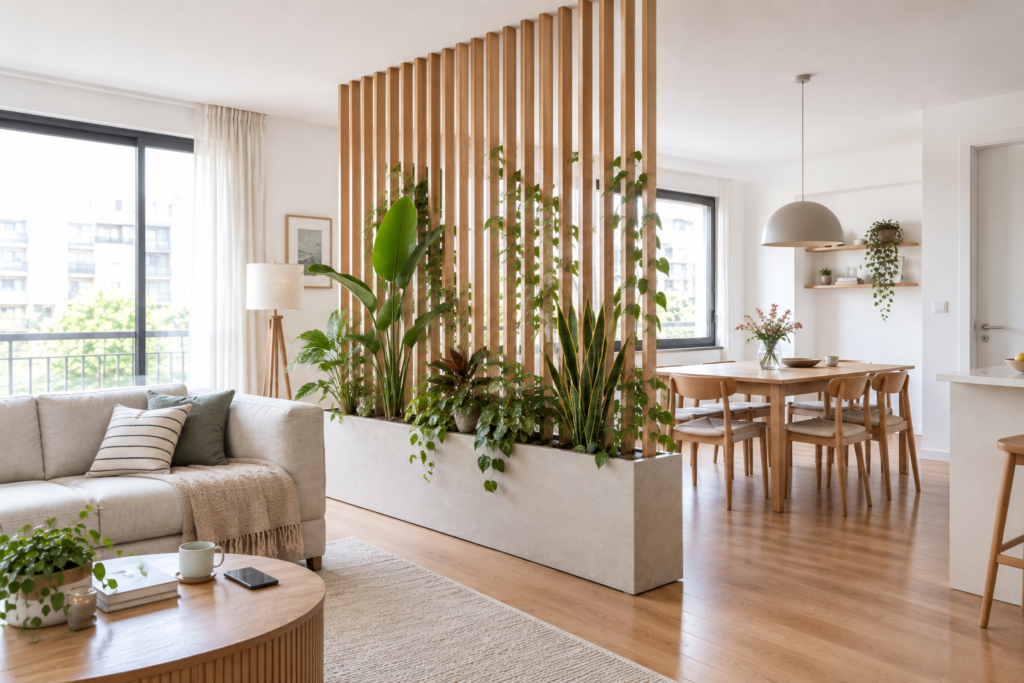
A slatted screen with an integrated planter combines a vertical architectural screen with a planting area built into its base. The slats create the physical separation, while the planter introduces greenery into the same overall structure.
The defining feature is the repeated vertical slat pattern combined with a planter built into the base of the screen. The slats remain aligned within a consistent screen plane, rather than changing direction from panel to panel.
How It Works as a Room Divider
The parallel vertical slats filter the view between two areas without creating the visual weight of a solid wall. Their consistent alignment creates a defined screen plane, while the integrated planter adds greenery at the base. Their spacing determines how much of the opposite side remains visible, while the plants add another layer of visual separation near floor level.
This makes the solution useful when you want a clearly defined boundary but still want daylight and some visual connection between the spaces.
Best For
- Open-plan living and dining areas
- Separating two zones without fully closing them off
- Spaces where an architectural-looking divider is preferred
Advantages & Limitations
Advantages
- Creates strong visual definition between zones
- Combines structure and planting in one solution
- Can provide more privacy than a completely open plant display
Limitations
- Less flexible than a freestanding mobile solution
- Requires more planning than simply adding individual plants
- The slat spacing and plant density need to be balanced
Plants & Maintenance
Medium-height plants with upright or moderately spreading growth can work well without completely hiding the slatted structure. Keeping the planting density controlled also makes the screen itself remain visually legible.
Because the plants are integrated into the divider, access for watering and pruning should be considered when positioning the planter. Where you place the divider also affects how well the plants can grow, so see our guide to Better Ways to Place Indoor Plants for practical placement guidance
Ratings
Its strongest characteristics are visual separation, openness, and plant capacity. It provides a more defined boundary than a loose collection of plants while retaining some visual permeability.
Privacy:
Openness & Light:
Flexibility:
Space Efficiency:
Ease of Setup:
Plant Capacity:
Maintenance:
Affordability:
Plant-Filled Open Shelving Divider
What It Is
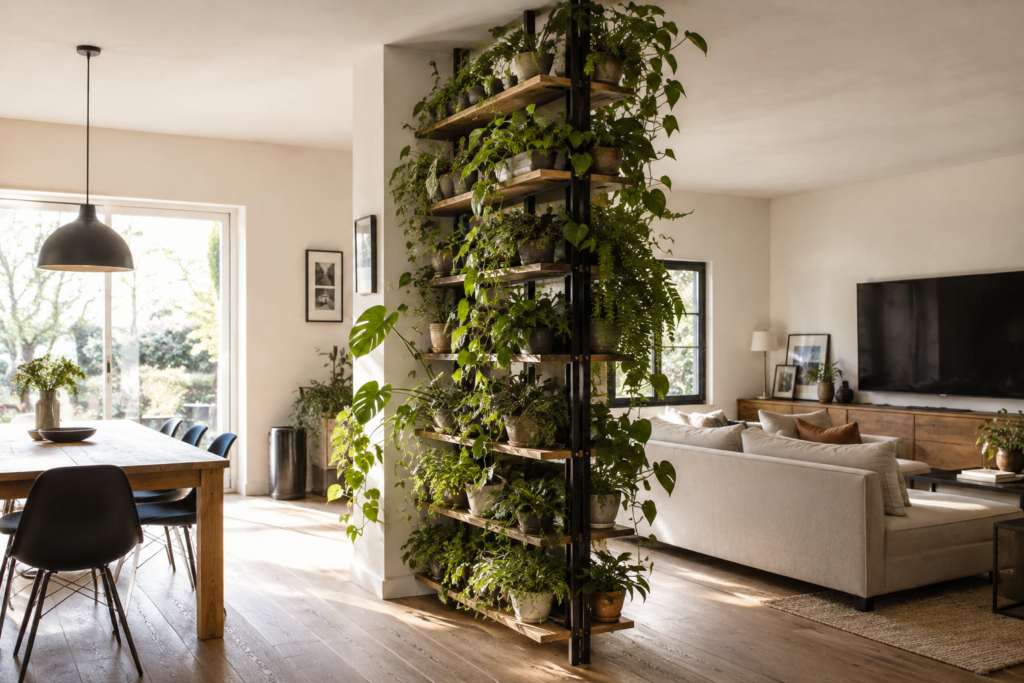
A plant-filled open shelving divider uses a freestanding or floor-supported shelving structure to separate two areas while keeping the space visually connected.
The defining feature is the combination of a vertical shelving framework and multiple horizontal planting surfaces. Unlike a conventional room divider, the structure does not rely on a solid panel. Plants are distributed across the shelves, allowing the greenery itself to become the visual screen.
The shelving can be styled as a mixed display with plants and decorative objects, or it can be filled almost entirely with plants for a much stronger living-wall effect.
How It Works as a Room Divider
The shelving establishes the boundary between two zones without creating a solid wall. Open gaps between the shelves preserve light and visual connection, while the plants gradually fill those openings and create a softer layer of separation.
Plant density determines how much of the opposite side remains visible. A lightly planted arrangement keeps the shelving visually open, while a densely planted structure can create a much stronger green screen.
Because the plants are distributed vertically across several levels, the divider can use very little floor width while still creating a substantial visual presence from floor to ceiling.
Best For
- Open-plan living and dining areas
- Separating two zones without building a solid wall
- Creating a strong plant-focused architectural feature
- Floor-to-ceiling greenery where floor space is limited
- Rooms that can benefit from both display shelving and plant storage
Advantages & Limitations
Advantages
- Creates a strong visual boundary while preserving openness
- Uses vertical space efficiently
- Can hold a large number of plants across multiple levels
- Allows the density of the greenery to control visual separation
- Can function as either a plant-focused display or a mixed storage-and-display unit
Limitations
- Requires meaningful floor depth compared with a wall-mounted plant display
- A heavily planted structure can become visually and physically heavy
- Plants on upper shelves can be harder to water and maintain
- The structure needs to be stable enough to support the combined weight of shelves, containers, and plants
Because open shelving can combine plants with other objects, keeping the arrangement visually controlled matters. See our guide to How to Style Indoor Plants So Your Home Looks Clean for practical ways to avoid a cluttered look.
Plants & Maintenance
Small, medium, and trailing indoor plants can all work well on open shelving. Combining different leaf sizes, growth habits, and heights creates a layered effect and helps soften the rigid geometry of the shelving.
For a plant-dominant divider, plants can occupy most or even nearly all of the shelves. Trailing plants can extend beyond the structure, while upright and bushier plants fill the middle layers.
The higher the shelving, the more important access becomes. Choose plants that can tolerate the available light and make sure upper shelves remain reachable for watering, pruning, and inspection.
Ratings
This option is particularly strong when you want to combine room division with a substantial vertical plant display. Its main advantage is the ability to create a strong green presence without replacing an open-plan layout with a solid wall.
Privacy:
Openness & Light:
Flexibility:
Space Efficiency:
Ease of Setup:
Plant Capacity:
Maintenance:
Affordability:
Trellis + Climbing Plants
What It Is
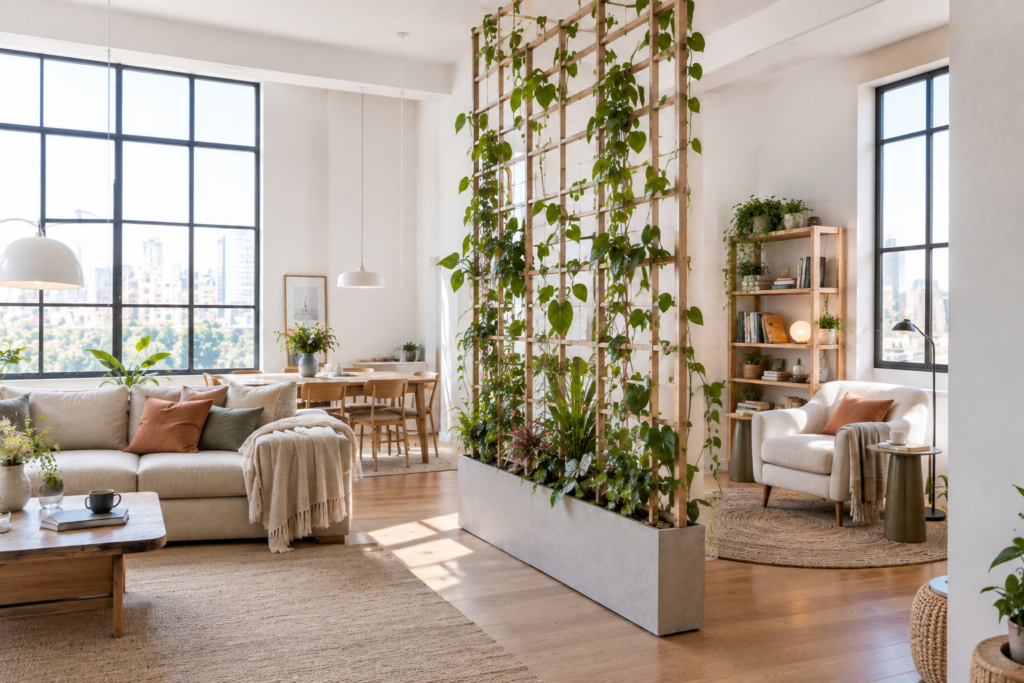
A trellis plant divider uses a structural support for climbing plants to grow through or across the divider. Unlike a conventional screen decorated with plants, the vegetation is an essential part of how this solution develops its visual separation.
How It Works as a Room Divider
The trellis provides a climbing surface, and the plants progressively grow through and across that structure to create the visual screen. The vegetation is therefore trained onto the support rather than suspended from it or simply placed beside it.
The amount of separation therefore depends partly on the eventual growth and density of the plants.
Best For
- Creating a greener visual boundary over time
- Open-plan rooms where some transparency is desirable
- Spaces where a relatively lightweight structural solution is preferred
Advantages & Limitations
Advantages
- Efficient use of vertical space
- Can provide a strong combination of greenery and visual separation
- Generally more accessible than custom architectural dividers
Limitations
- Plants need ongoing training and pruning
- The finished appearance develops over time
- Once heavily established, moving or rearranging the setup becomes less practical
Plants & Maintenance
Choose climbing plants that can actually use the trellis as a support. Their stems and foliage need to grow through or across the trellis, so growth direction may need to be guided and pruning may be necessary to maintain the desired amount of openness.
The goal is not simply maximum foliage. Maintaining some of the trellis openings helps preserve its function as a room divider.
Ratings
The trellis performs particularly well for space efficiency, setup, and accessibility, while flexibility becomes more limited as the plants become established.
Privacy:
Openness & Light:
Flexibility:
Space Efficiency:
Ease of Setup:
Plant Capacity:
Maintenance:
Affordability:
Rolling / Mobile Plant Divider
What It Is
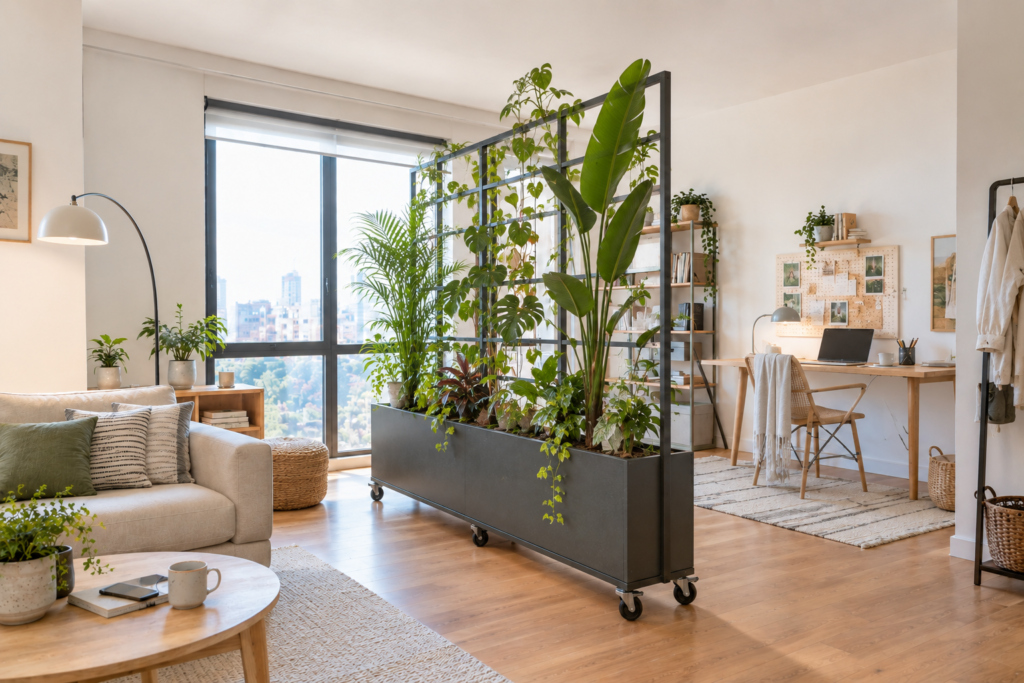
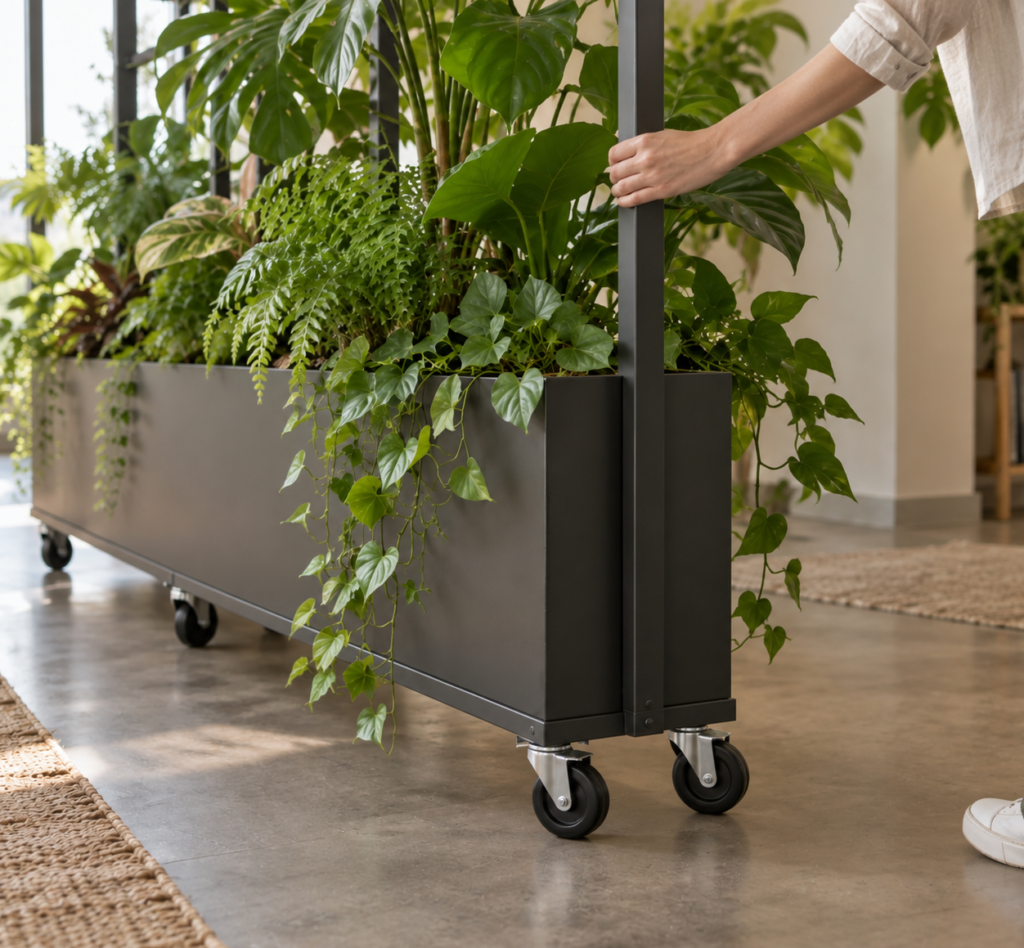
A rolling plant divider is a freestanding plant-containing divider mounted on casters or another mobile base. Its defining characteristic is that the entire divider can be physically repositioned.
How It Works as a Room Divider
The divider can be placed between two zones when separation is useful and moved aside when the room needs to feel more open. Its flexibility comes primarily from physical mobility: the entire divider can be moved to a different position when the room layout changes.
This makes it particularly different from fixed planters, screens, and architectural partitions: the spatial boundary itself can change position.
Best For
- Flexible open-plan apartments
- Multifunctional rooms
- Spaces that need different configurations throughout the day
Advantages & Limitations
Advantages
- Excellent mobility
- Can adapt to changing room layouts
- Provides a plant-filled divider without permanently defining one location
Limitations
- Requires clear floor space for movement
- A heavily planted unit can become difficult to move
- Stability and weight need to be considered
Plants & Maintenance
Choose plants that can tolerate the lighting conditions of the locations where the divider will be used. If you’re unsure how to evaluate the light available in different parts of a room, see our guide to Indoor Plant Light Requirements. Keep weight distribution in mind, particularly if the planter is frequently moved.
Watering should also be planned around the unit’s mobility so that moving it does not become unnecessarily cumbersome.
Ratings
This is the strongest option in the guide for flexibility and mobility.
Privacy:
Openness & Light:
Flexibility:
Space Efficiency:
Ease of Setup:
Plant Capacity:
Maintenance:
Affordability:
Freestanding Metal Frame + Hanging Plants
What It Is
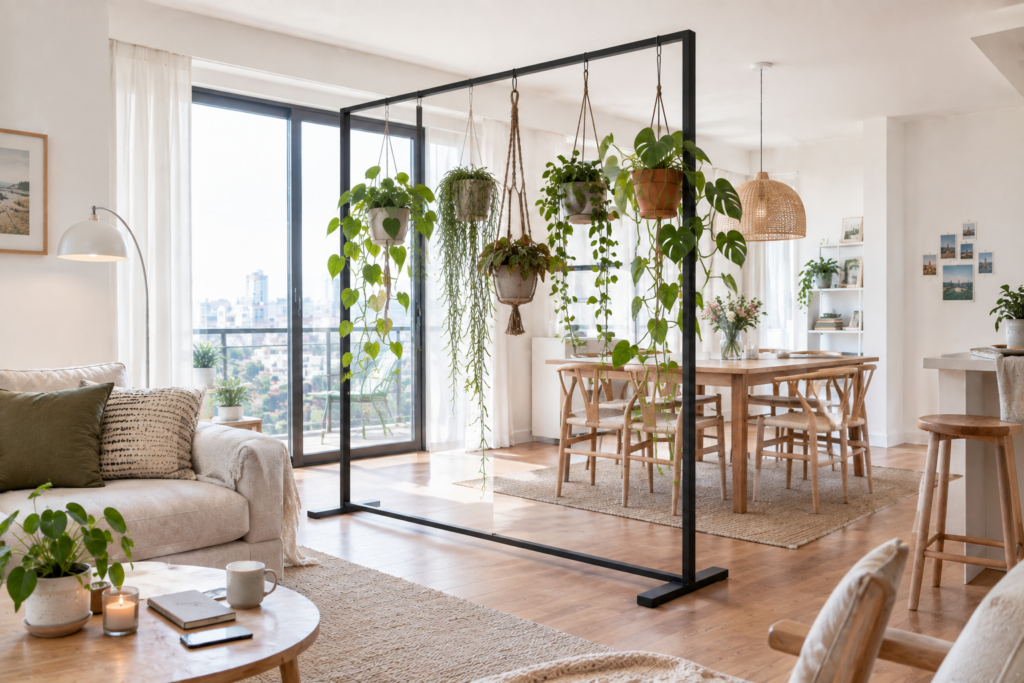
This solution uses a freestanding metal frame with multiple hanging plants suspended from attachment points along the upper structure.
The important distinction is the physical sequence:
freestanding frame → suspension points → hanging plants.
The frame stands independently and does not rely on the ceiling or walls.
The plants are suspended from the freestanding frame rather than growing through a screen or being planted into a continuous base.
How It Works as a Room Divider
The floor-supported frame establishes the boundary while the hanging plants create a softer visual filter within its open volume. Because the structure remains largely open, the two zones can stay visually connected.
The plants can be distributed at different heights to create separation without turning the divider into an opaque wall.
Best For
- Living and dining transitions
- Lightweight visual separation
- Spaces where floor-level planting would take up too much room
Advantages & Limitations
Advantages
- Visually lightweight
- Good openness and light transmission
- Uses vertical space efficiently
- Can accommodate several hanging plants
Limitations
- Provides moderate rather than maximum privacy
- Hanging plants require accessible watering
- The frame needs enough stability to support its suspended load
Plants & Maintenance
Trailing and hanging plants work naturally with this structure. Varying the hanging heights helps create a more organic screen.
Keep enough open space between plants that the metal frame remains visible and the plants do not turn the divider into an unintentionally dense wall.
Ratings
Its strongest combination is openness, space efficiency, setup, and plant capacity.
Privacy:
Openness & Light:
Flexibility:
Space Efficiency:
Ease of Setup:
Plant Capacity:
Maintenance:
Affordability:
Long Planter Box + Tall Plants
What It Is
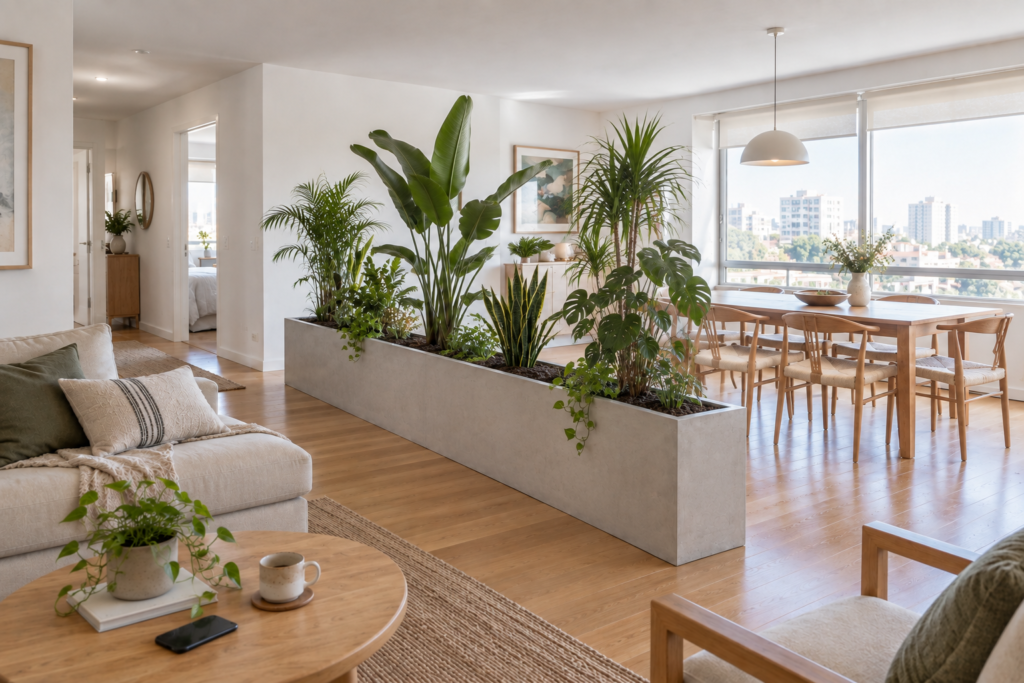
A long planter box creates a single continuous linear boundary between two areas. Multiple tall plants are planted directly into the same planter rather than being placed in separate containers.
The continuous geometry is the defining characteristic.
How It Works as a Room Divider
The planter establishes a strong physical line through the room, while the tall plants extend the visual boundary upward. Because the vegetation does not need to reach the ceiling, the arrangement can still preserve some openness above it.
The planting is the main vertical element: the long planter provides the base, while the tall plants create most of the divider’s visual height.
Its long footprint makes it particularly suited to rooms with a linear layout.
Best For
- Long open-plan layouts
- Living/dining transitions
- Spaces that need a strong plant-based visual boundary
Advantages & Limitations
Advantages
- Very high planting capacity
- Strong visual separation
- Creates a unified architectural boundary
Limitations
- Requires substantial floor length
- Difficult to relocate once planted
- Can become heavy and cumbersome
Plants & Maintenance
Tall indoor plants with upright growth create the clearest room-divider effect. Varying their heights keeps the planting natural while preserving the continuous geometry of the planter.
Because several plants share one container, watering, pruning, and access should be considered as part of the overall layout.
Ratings
This is the strongest solution in the group for privacy and plant capacity, but it sacrifices mobility and requires considerable floor space.
Privacy:
Openness & Light:
Flexibility:
Space Efficiency:
Ease of Setup:
Plant Capacity:
Maintenance:
Affordability:
Hanging Plant Curtain
What It Is
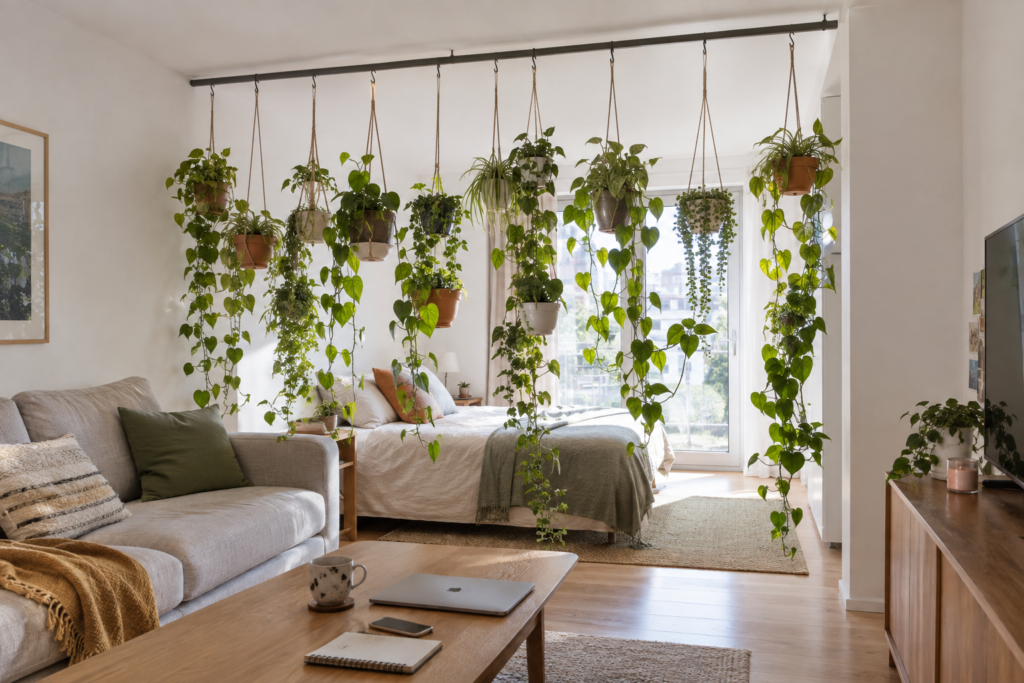
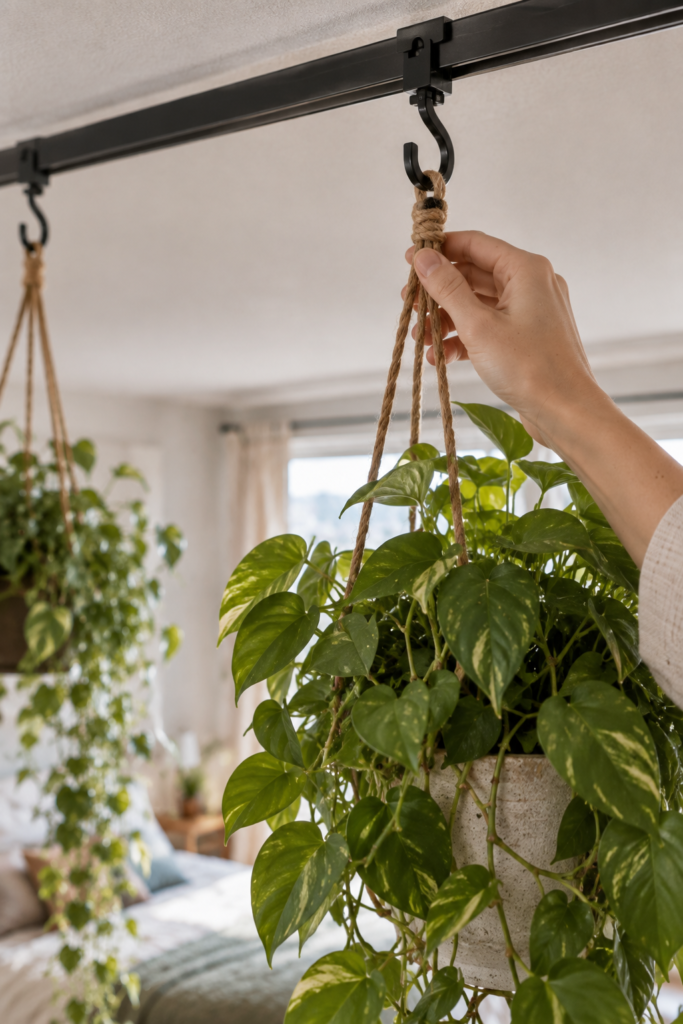
A hanging plant curtain creates a vertical band of individual plants suspended from a horizontal upper support. Unlike the freestanding frame option, there are no floor-supported vertical posts forming the divider.
Unlike the freestanding frame approach, the curtain has no floor-supported vertical frame. The visual divider is created by plants suspended from the upper support.
How It Works as a Room Divider
Multiple suspension lines create a repeated vertical rhythm, while the plants themselves form the main visual filter between the two spaces. The repeated hanging arrangement creates the curtain effect without a floor-supported divider frame.
Different hanging lengths and natural spacing prevent the arrangement from reading as a row of identical plants and instead create a curtain-like visual boundary.
Best For
- Living and sleeping areas
- Studio apartments
- Spaces where keeping the floor relatively open is important
Advantages & Limitations
Advantages
- Minimal floor footprint
- Strong visual identity
- Allows light and views to pass through the foliage
Limitations
- Depends on a suitable upper support
- Multiple hanging plants can be demanding to water
- Less convenient to reposition than a mobile floor-standing divider
Plants & Maintenance
Trailing plants are particularly effective because their foliage can extend downward and create the curtain effect.
Different suspension heights can produce a more natural screen, but each individual plant still needs reliable access for watering and maintenance. The main maintenance challenge is access: several plants may need to be watered, pruned, and checked individually while suspended above the floor.
Ratings
Its strongest advantages are space efficiency and visual separation, while maintenance is more demanding because multiple plants are suspended overhead.
Privacy:
Openness & Light:
Flexibility:
Space Efficiency:
Ease of Setup:
Plant Capacity:
Maintenance:
Affordability:
Partial-Height Plant Partition
What It Is
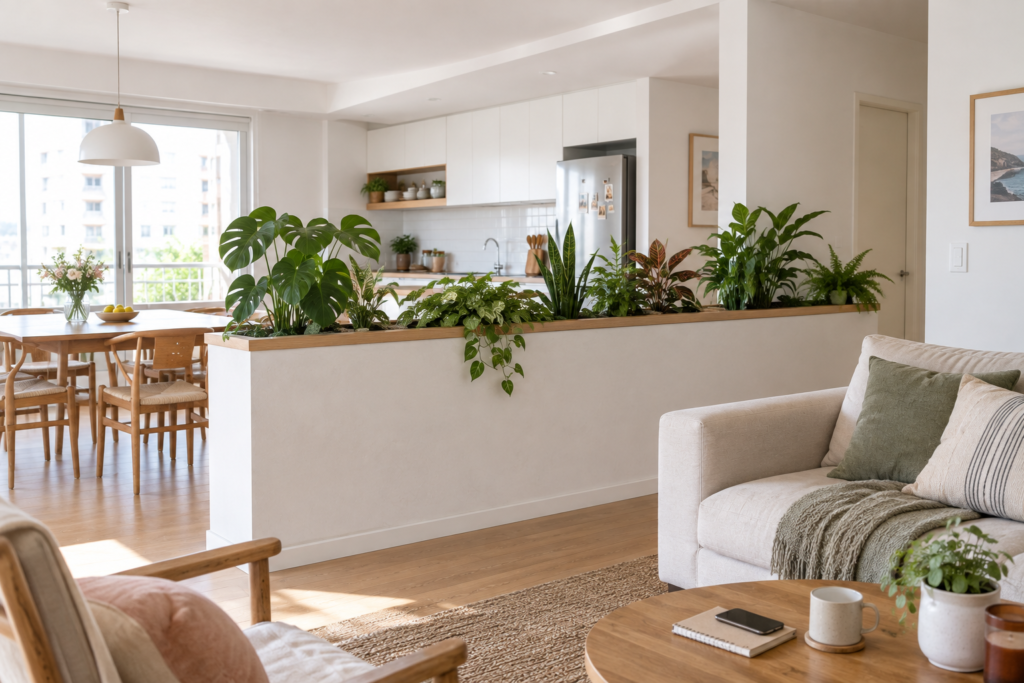
A partial-height plant partition is a continuous architectural planter that rises only to around waist or chest height. Plants grow directly from the integrated planter and extend above the solid base. Its defining characteristic is its low, linear profile rather than a tall or sculptural divider form.
How It Works as a Room Divider
The architectural base provides much of the physical boundary, while the plants add a secondary visual layer above it. The partition remains well below the ceiling, leaving substantial open space above rather than allowing the vegetation to create the full height of the divider.
That open upper area allows the two sides to remain directly connected.
Best For
- Kitchen and living room transitions
- Living and dining zones
- Spaces where full privacy is unnecessary
Advantages & Limitations
Advantages
- Excellent openness
- Clearly defines the two zones
- Plants remain relatively accessible
- Does not visually close the room
Limitations
- Limited privacy
- Requires a fixed architectural footprint
- The planter must be carefully positioned to preserve circulation
Plants & Maintenance
Medium-height plants work best. They should rise above the planter enough to create a visual layer without filling the entire space toward the ceiling.
The low planting height keeps most plants relatively accessible for routine watering, pruning, and inspection, making routine maintenance easier than with suspended arrangements.
Ratings
Its standout characteristic is openness and light, making it particularly useful when visual connection is more important than privacy.
Privacy:
Openness & Light:
Flexibility:
Space Efficiency:
Ease of Setup:
Plant Capacity:
Maintenance:
Affordability:
Modular Plant Partition
What It Is
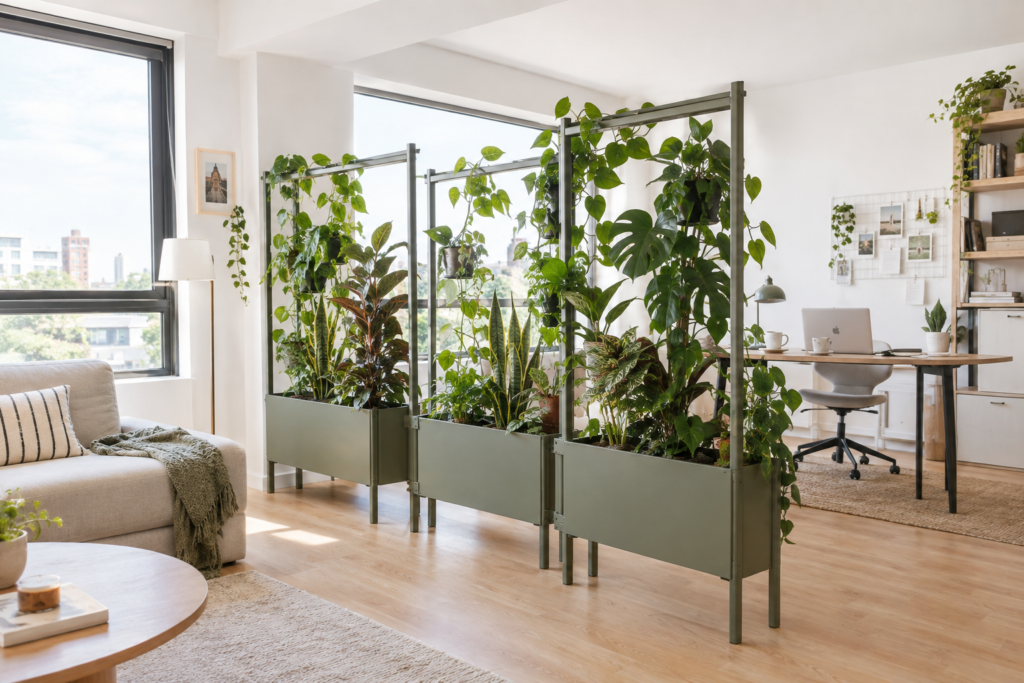
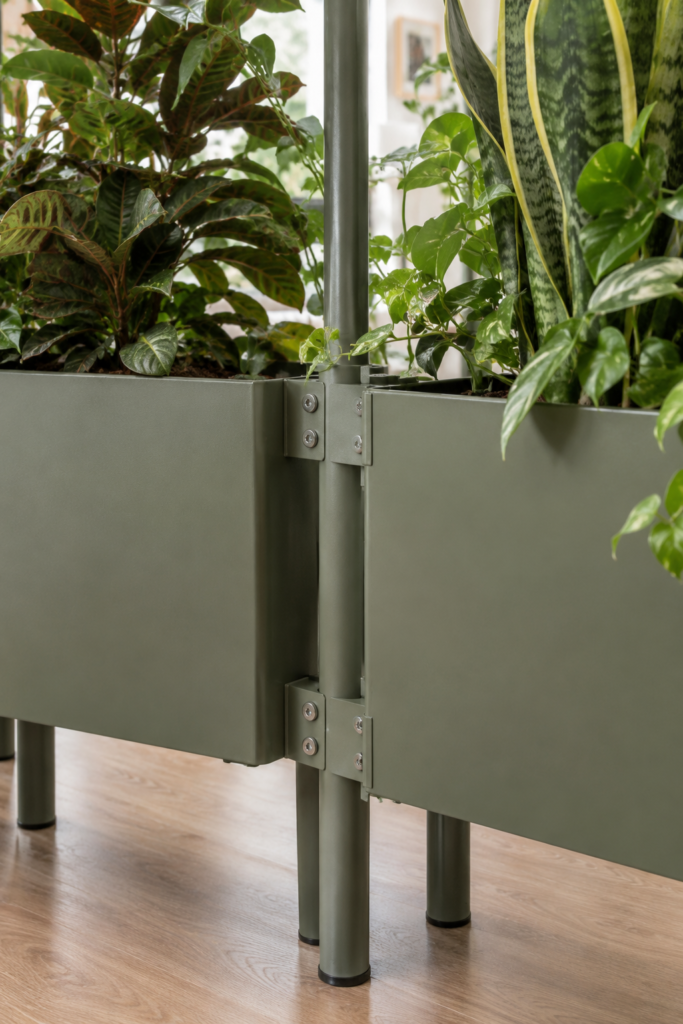
A modular plant partition consists of multiple connected modules that use a repeatable structural and planting system. Each module has its own planting area and connects physically to neighboring modules.
The defining characteristic is modularity, rather than simply having several planters next to one another.
The modules are part of the structure itself, not simply separate planters positioned beside one another.
How It Works as a Room Divider
Multiple modules can form a longer divider, while their arrangement can potentially be adapted to the space. Its flexibility comes from its modular construction: the divider can be expanded, shortened, or rearranged by changing the module configuration.
The connections make the units read as one expandable system rather than unrelated plant containers.
Best For
- Flexible open-plan layouts
- Spaces that may need different configurations
- People who want an expandable plant-divider system
Advantages & Limitations
Advantages
- Very high flexibility
- High planting capacity
- Can adapt to different lengths and arrangements
Limitations
- More components mean more assembly
- Connections need to remain stable
- The footprint can grow significantly depending on configuration
Plants & Maintenance
Because planting is distributed between modules, plants can be selected and maintained individually. This can also make it easier to vary plant heights and density across the divider.
Keeping the modules visually consistent helps preserve the appearance of one coherent system.
Ratings
This solution stands out for flexibility and plant capacity.
Privacy:
Openness & Light:
Flexibility:
Space Efficiency:
Ease of Setup:
Plant Capacity:
Maintenance:
Affordability:
Angled Plant Divider
What It Is
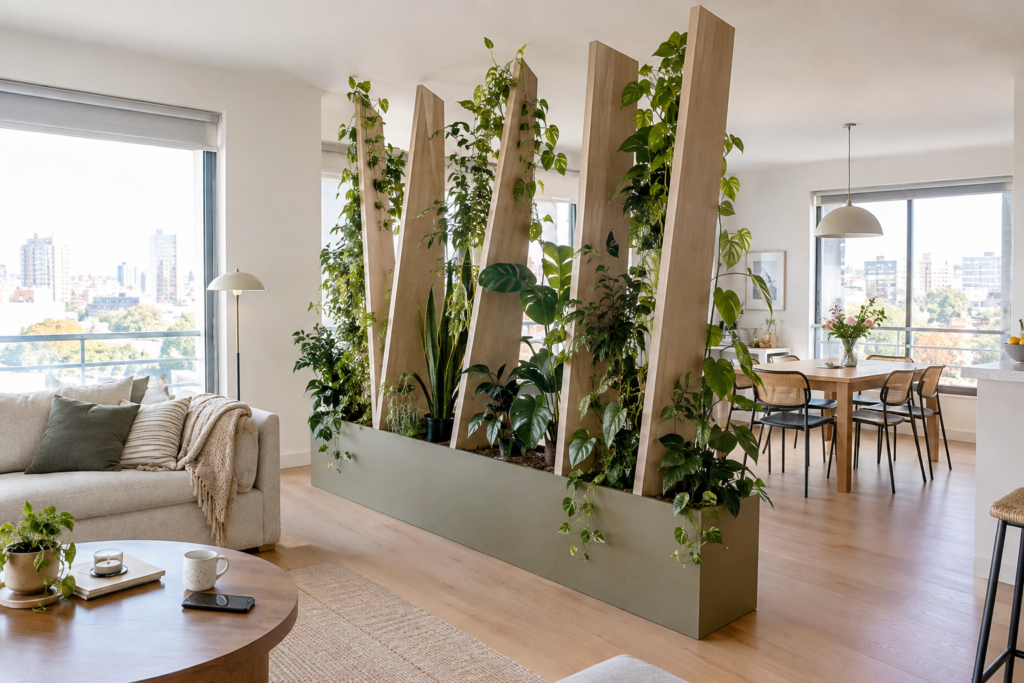
An angled plant divider uses multiple tall structural panels positioned at different angles to form one freestanding spatial boundary.
Unlike a conventional slatted screen, the panels do not form one uniform plane. Their changing angles are the defining feature of the divider.
The defining feature is the changing orientation of the panels.
How It Works as a Room Divider
The panels change direction from one panel to the next rather than forming one continuous plane. This creates changing degrees of openness through the divider: depending on the viewing position, some panels screen more of the opposite zone while others leave larger openings.
The geometry itself therefore performs the dividing function; the plants are secondary to that structural concept.
Best For
- Contemporary interiors
- Spaces where geometry is part of the design
- Situations where a dynamic visual boundary is preferred over a straight screen
Advantages & Limitations
Advantages
- Strong architectural character
- Creates varied degrees of visual openness
- Can provide substantial visual separation
Limitations
- More complicated to construct
- Less accessible than simpler divider types
- Requires enough floor area for the angled geometry to work effectively
Plants & Maintenance
Plants should complement rather than hide the angled structure. Medium-to-tall plants can occupy the integrated planting areas while leaving enough structural material visible to make the changing angles immediately readable.
Ratings
Its strongest attribute is visual separation, while its custom geometry makes setup and cost less favorable.
Privacy:
Openness & Light:
Flexibility:
Space Efficiency:
Ease of Setup:
Plant Capacity:
Maintenance:
Affordability:
Curved Plant Room Divider
What It Is
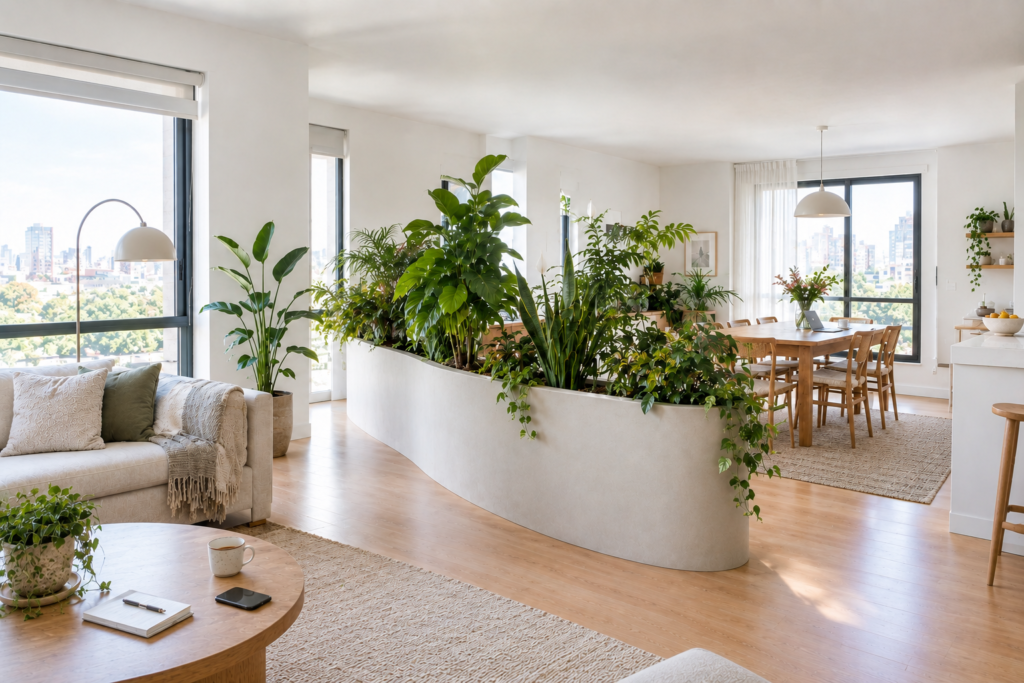
A curved plant room divider uses one substantial continuous curved structure with an integrated planter running along it. The divider follows a sweeping path rather than a straight line.
The physical curve is the defining feature. Unlike an angled divider that changes direction from panel to panel, this structure changes direction continuously along one uninterrupted form.
How It Works as a Room Divider
The curved structure changes direction gradually through the room, creating a boundary that can partially wrap around one zone while preserving visual connections around the curve. The continuous curve, rather than a series of separate planters, is what creates the spatial boundary.
The result is fundamentally different from arranging several straight planters in an arc: the planter and divider are one continuous architectural construction.
Best For
- Larger contemporary apartments
- Open-plan rooms with sufficient floor area
- Spaces where the divider itself is intended to become an architectural feature
Advantages & Limitations
Advantages
- Strong spatial definition
- Distinctive architectural form
- Can guide movement and create different relationships between the two zones
Limitations
- More difficult and expensive to construct
- Difficult to modify after installation
- Requires sufficient room around the curve
Plants & Maintenance
Plants should be selected according to the depth and shape of the integrated planter while keeping the curved silhouette visible.
A mixture of medium and tall plants can add vegetation without completely obscuring the architecture. The plants themselves can be maintained much like other container-grown indoor plants, but the long curved planter can make access to some planting areas less convenient.
Ratings
The curved divider offers strong visual separation and architectural definition, but it scores lower for setup, flexibility, and accessibility because the geometry is substantially more involved.
Privacy:
Openness & Light:
Flexibility:
Space Efficiency:
Ease of Setup:
Plant Capacity:
Maintenance:
Affordability:
Which Indoor Plant Divider Is Right for You?
There is no single best indoor plant divider for every room. The right choice depends on which trade-off matters most.
If you’re working with a small or multifunctional apartment, the layout itself can make a major difference. See 5 Plant Layout Fixes That Change Everything for practical ways to rethink where plants and zones sit within a room.
For maximum privacy: the Long Planter Box + Tall Plants provides the strongest visual separation of the 11 options.
For maximum openness and light: the Partial-Height Plant Partition leaves the largest amount of open space above the divider.
For maximum flexibility: the Rolling / Mobile Plant Divider and Modular Plant Partition stand out because their configurations can change more easily.
For small or space-conscious layouts: the Trellis + Climbing Plants, Freestanding Metal Frame + Hanging Plants, and Hanging Plant Curtain make particularly effective use of vertical space.
For shelving plus greenery: the Plant-Filled Open Shelving Divider combines room division with a vertical display system. It can be styled with a mixture of plants and everyday objects, or filled predominantly with plants for a much stronger green-screen effect.
For a strong architectural statement: the Angled Plant Divider and Curved Plant Room Divider make the geometry itself part of the room’s design.
For a straightforward partial boundary: the Partial-Height Plant Partition offers a useful middle ground between a completely open layout and a more substantial divider.
The best indoor plant divider is ultimately the one whose level of separation, footprint, flexibility, planting capacity, and maintenance requirements match the way you actually use the room.
Whichever divider you choose, avoid adding more plants than the space can visually support. Indoor Plant Decor Mistakes That Make Your Home Look Messy covers common styling problems that can make a healthy plant collection feel cluttered.