
Most indoor plants live on the floor, shelves, windowsills, and tables. But one of the largest surfaces in your home often remains completely empty: the ceiling.
An indoor plant canopy changes that.
Instead of treating hanging plants as isolated decorations, you can use them to create an overhead layer of greenery that changes how an entire room feels. Depending on the structure, a canopy can frame a dining table, soften a reading nook, create a jungle-like living room, or turn an unused ceiling into a dramatic focal point.
The key is to think beyond individual hanging pots. A successful plant canopy is a spatial composition: the support system, plant placement, hanging heights, density, and room beneath it all work together.
Here are 20 ways to create one.
Table of Contents
1. Build a Ceiling Plant Grid
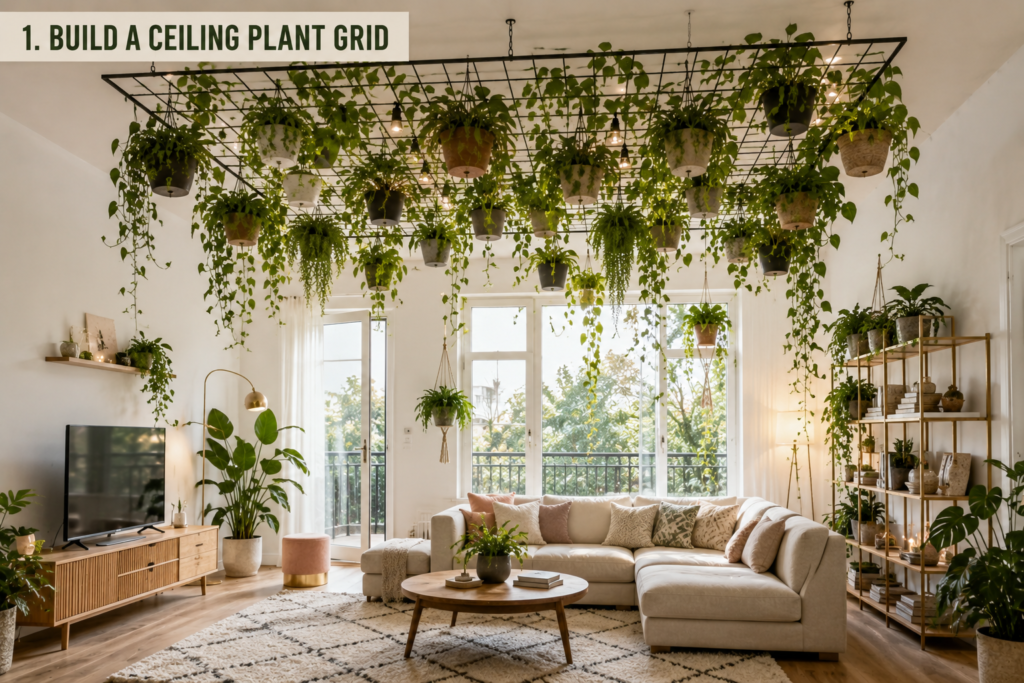
A ceiling grid provides one of the most flexible ways to build a dense plant canopy.
Mount a lightweight grid or overhead framework and use it as a series of suspension points for trailing plants. Instead of concentrating everything around one hook, the grid distributes the plants across the ceiling plane.
This works particularly well in larger living rooms, sunrooms, or spaces with exposed structural elements.
Use trailing plants such as pothos or philodendrons to allow the foliage to gradually soften the geometric structure.
Best for: large rooms and dramatic jungle-style interiors.
2. Create a Floating Hanging Cluster
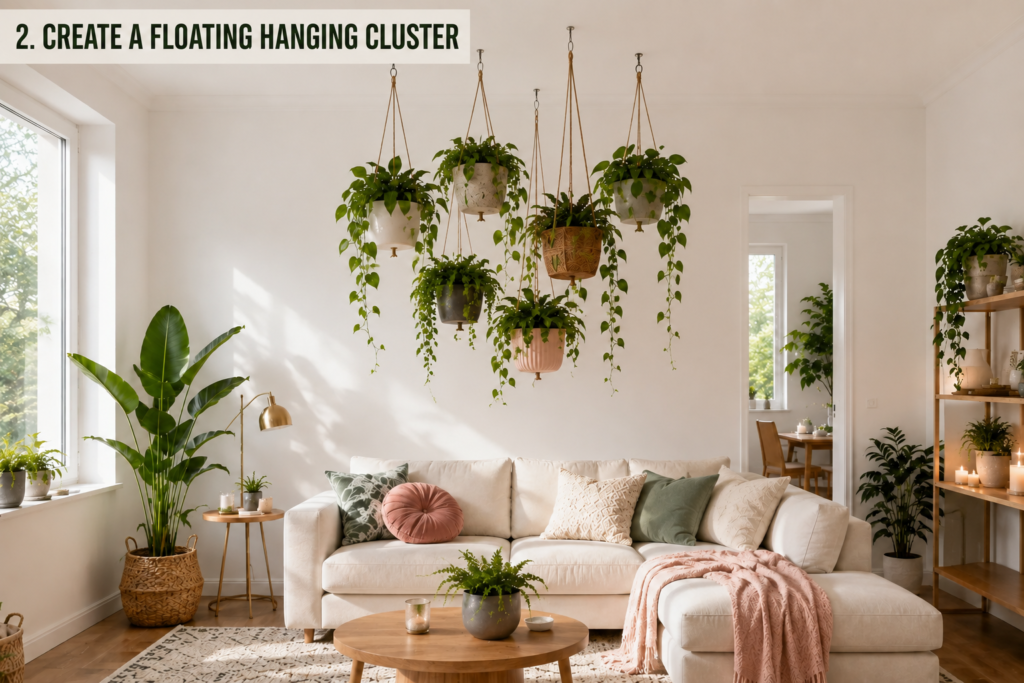
You don’t need to cover the entire ceiling.
Group several hanging planters together over one area of the room, using different hanging lengths to create a compact floating garden.
Keep enough space between the plants that each container remains visually distinct while the foliage overlaps naturally.
This approach works especially well above seating areas where you want to create a focal point without overwhelming the entire room.
Best for: living rooms and apartments.
3. Frame a Room With Perimeter Cascades
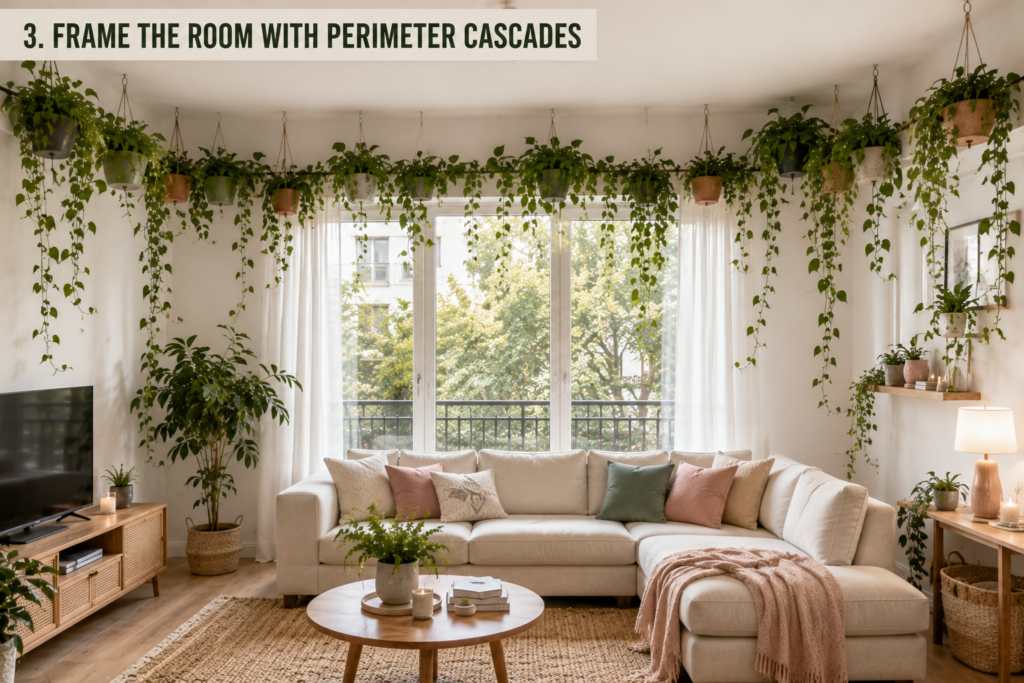
Instead of filling the middle of the ceiling, position trailing plants around the perimeter of a room.
Allow the vines to fall inward slightly, creating a green frame around the upper edges of the space.
This produces a canopy effect while preserving a relatively open center.
It is particularly effective in rooms with large windows because the foliage can create a soft transition between the walls and ceiling.
Best for: bright rooms and window-heavy spaces.
4. Hang Plants From Exposed Beams
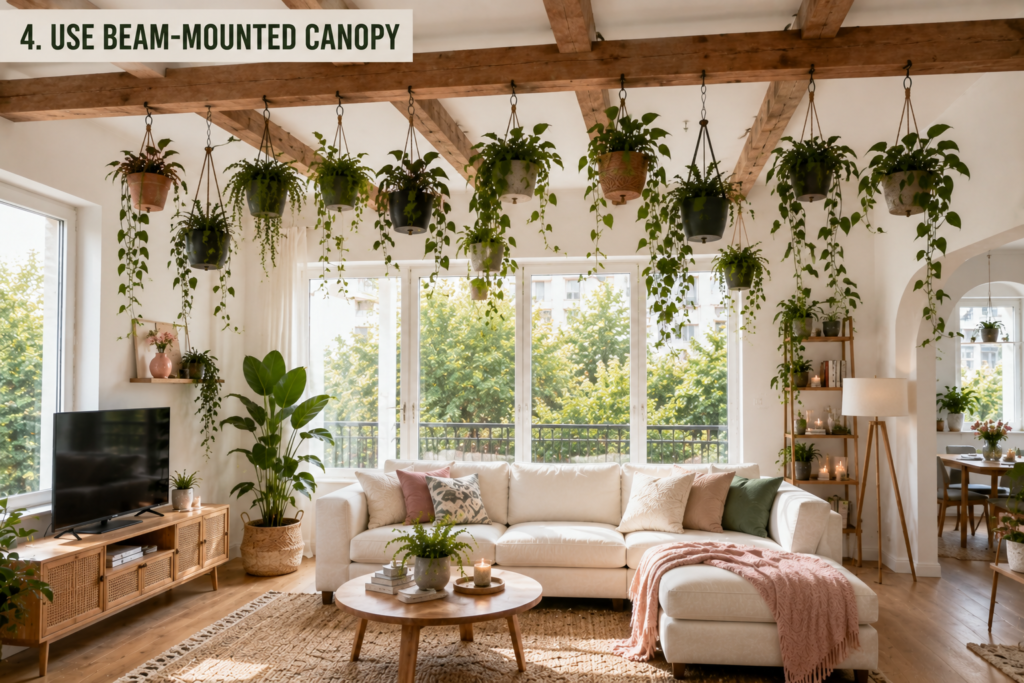
If your room already has exposed wooden beams, use them as the visual foundation for the canopy.
Suspend plants from several points along the beams and vary the lengths of the trailing foliage.
The existing architecture does most of the work, allowing the plants to feel integrated rather than added afterward.
Best for: homes with exposed beams or rustic architecture.
5. Create a Canopy Over the Dining Table
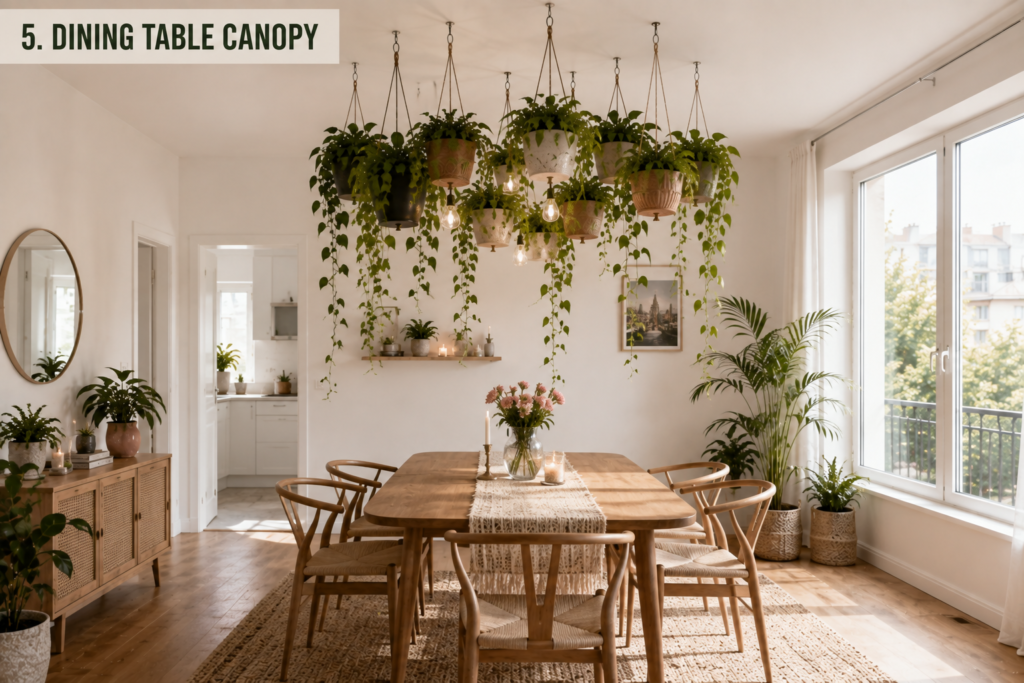
Create a concentrated canopy directly above the dining table.
Rather than spreading plants throughout the room, treat the dining zone as its own botanical ceiling.
The plants visually frame the table and can make a large or open dining area feel more intimate.
Keep the lowest foliage well clear of people’s heads and make sure every hanging plant remains accessible enough to water and maintain.
Best for: dining rooms and open-plan spaces.
6. Define a Sofa Zone With Plants
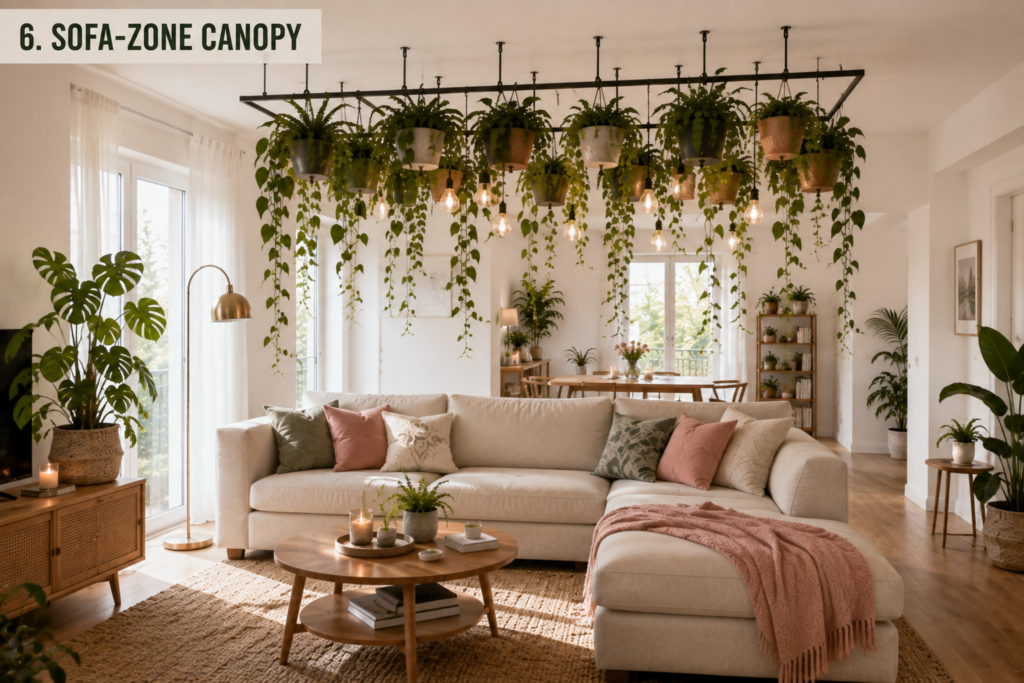
Use hanging plants to visually define the seating area of a large living room.
A cluster of plants positioned above and slightly behind the sofa creates a softer upper boundary without requiring a physical divider.
This is particularly useful when the room has a large amount of unused vertical space.
Best for: large living rooms and open-plan layouts.
7. Turn a Reading Nook Into a Green Retreat
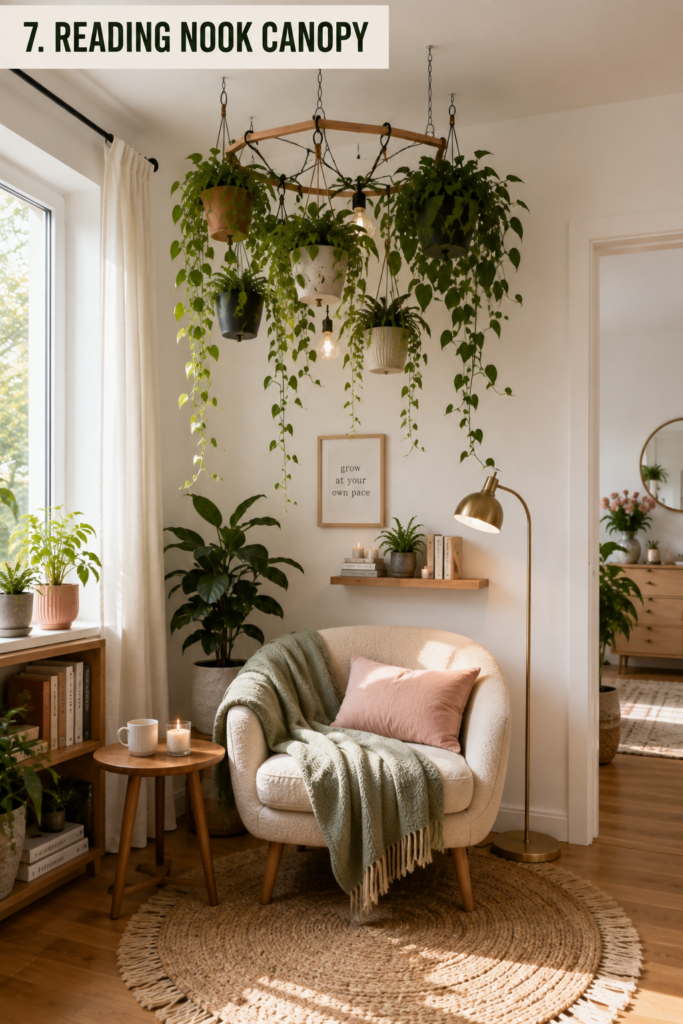
A small reading corner can become much more atmospheric with a localized plant canopy.
Suspend a few trailing plants above the chair rather than attempting to cover the entire ceiling.
The result is a contained green retreat that visually separates the nook from the rest of the room.
Choose plants whose mature trailing length will remain manageable around the seating area.
Best for: reading corners and small spaces.
8. Create a Botanical Bedroom Canopy
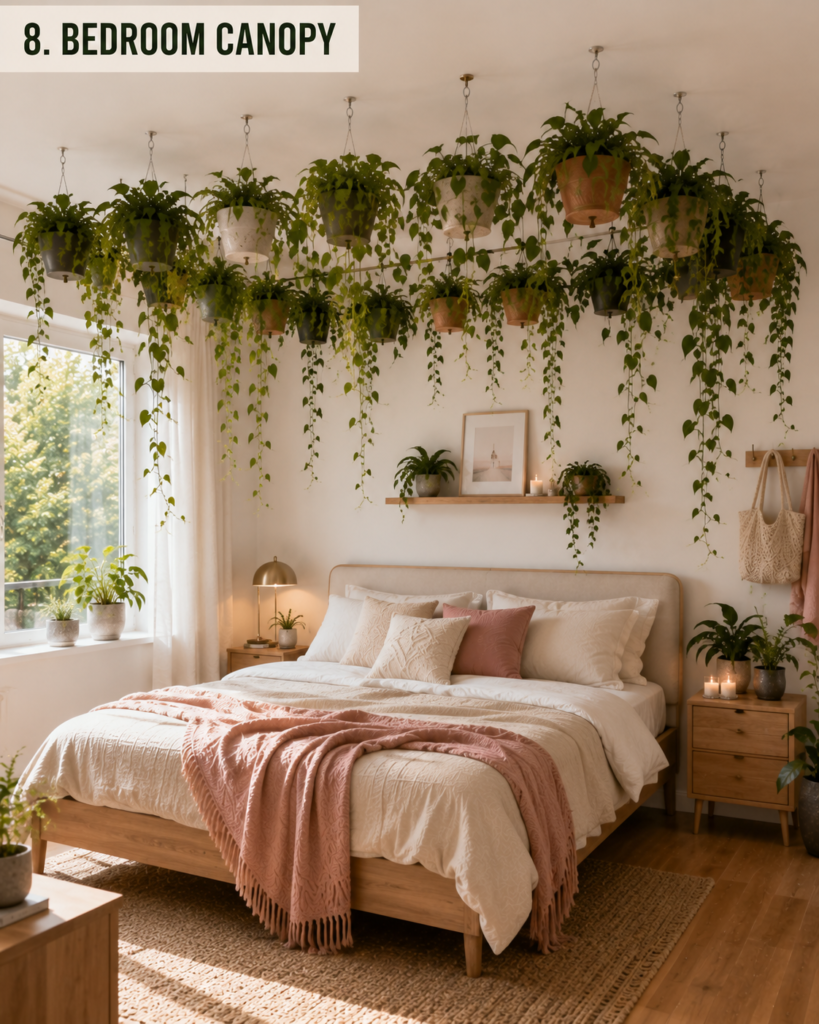
A bedroom can use a plant canopy to create a sheltered, botanical atmosphere.
The safest approach is to keep the installation visually concentrated around the perimeter or above the surrounding area rather than placing heavy containers directly over where someone sleeps.
Use lightweight containers and make sure all hardware is appropriate for the fully watered weight of the installation.
Best for: botanical bedrooms and canopy-bed-inspired interiors.
9. Train Vines From Wall to Ceiling
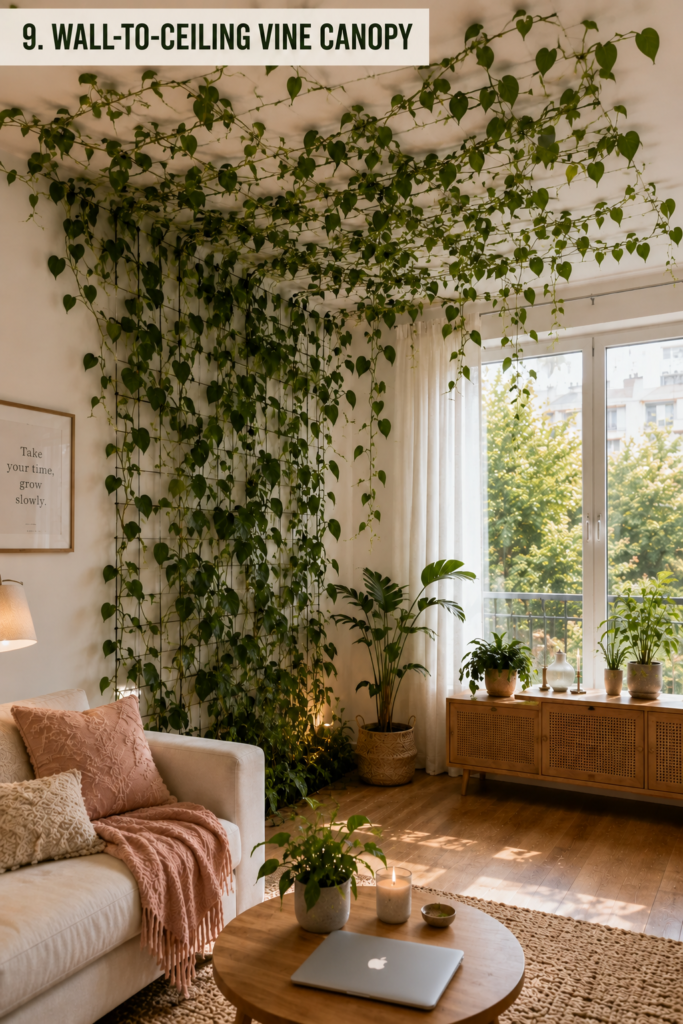
Instead of treating the wall and ceiling as separate surfaces, train vines to transition between them.
Begin with plants positioned high on the wall and guide selected growth upward and across the ceiling.
This creates the impression that the greenery is naturally spreading through the architecture.
It works particularly well when the objective is a dense indoor-jungle aesthetic rather than a collection of visibly suspended pots.
Best for: maximalist interiors and jungle-style rooms.
10. Install an Overhead Plant Rail
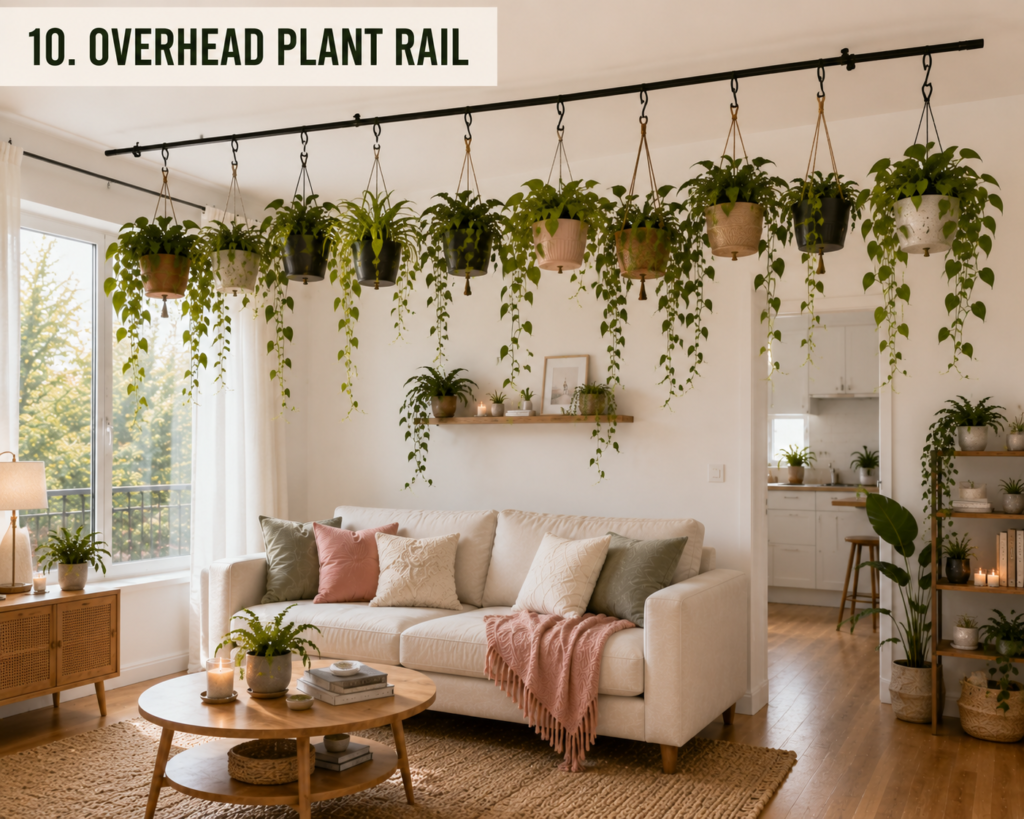
A horizontal rail can provide a clean, linear support system for several hanging plants.
Position the rail above a sofa, dining table, window, or other defined zone.
Because the suspension points can be distributed along one line, the result feels more deliberate and architectural than randomly positioned hanging plants.
Best for: modern interiors and linear furniture arrangements.
11. Layer Plants at Different Heights
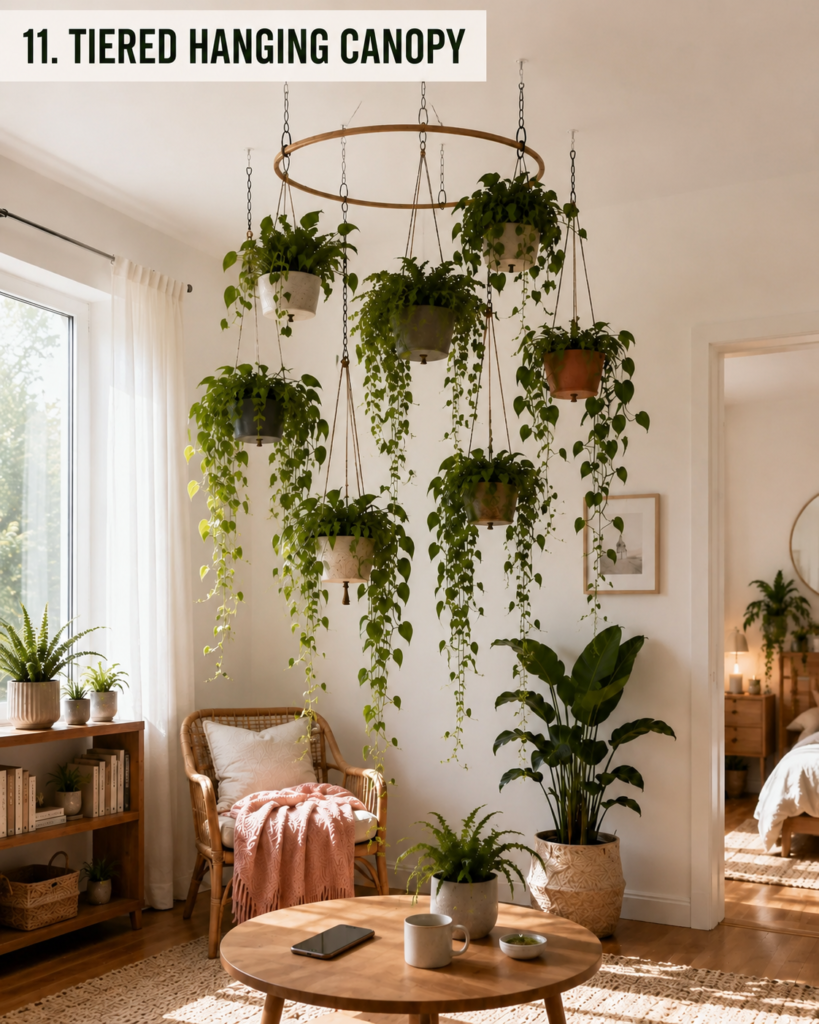
Create depth by suspending plants at different heights.
Rather than making every pot hang at exactly the same level, use a controlled progression of short, medium, and long drops.
The important distinction is intentional variation: the different heights should create a readable composition rather than visual clutter.
Best for: rooms that need more vertical depth.
12. Span a Room With Corner-to-Corner Cables
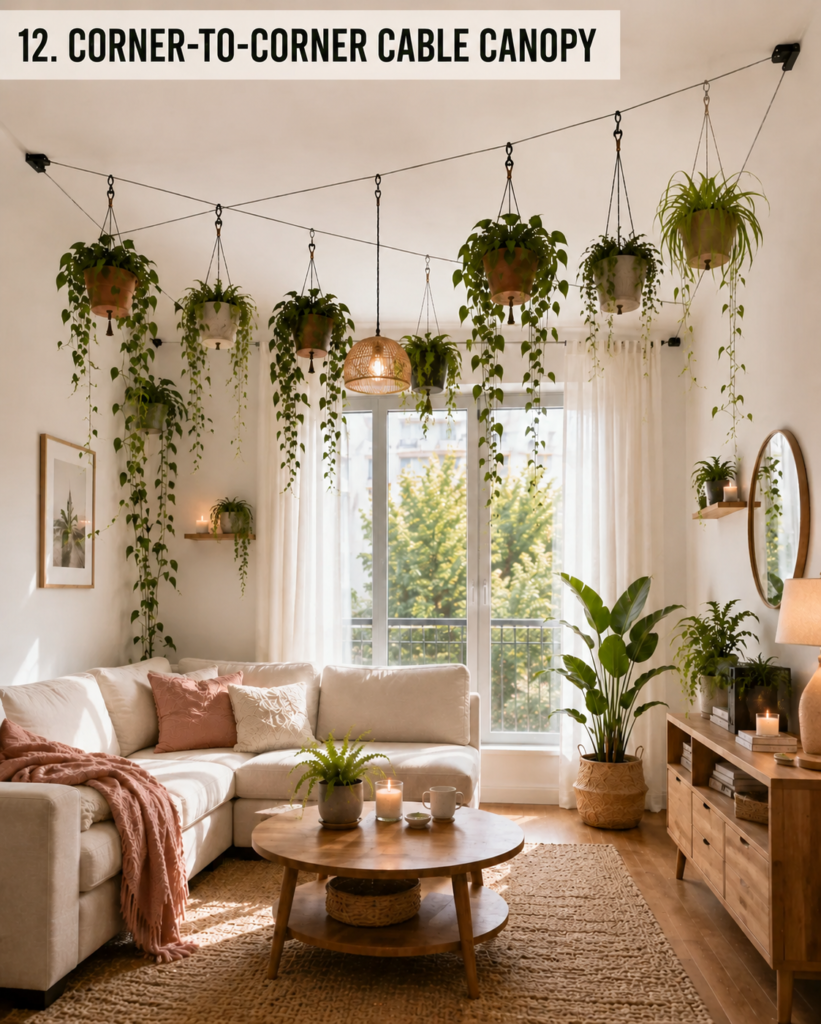
A cable-based system can create a visual framework that stretches across part of the ceiling.
Plants can then be attached at selected points along the system.
This approach is useful when you want the canopy to span a larger area without installing numerous isolated ceiling hooks.
The structure should remain visually clean so the plants—not a collection of loose wires—remain the dominant element.
Best for: larger spaces and contemporary interiors.
13. Grow Vines Across a Ceiling Trellis
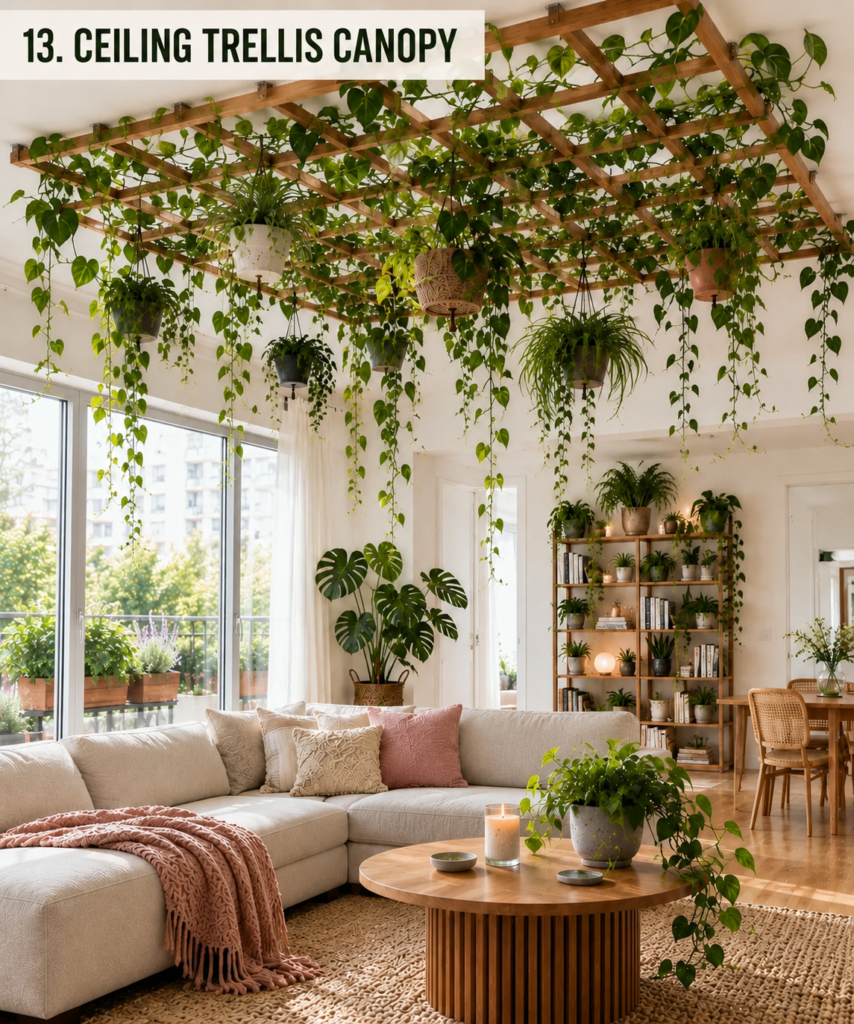
A trellis can function as an overhead growing structure rather than simply as a wall feature.
Train suitable vines across the trellis and allow selected stems to cascade downward.
Unlike individual hanging pots, this creates a more continuous botanical surface.
It is particularly effective when you want the plants to appear as though they are growing through the architecture.
Best for: dense green-ceiling effects.
14. Build a Circular Plant Canopy
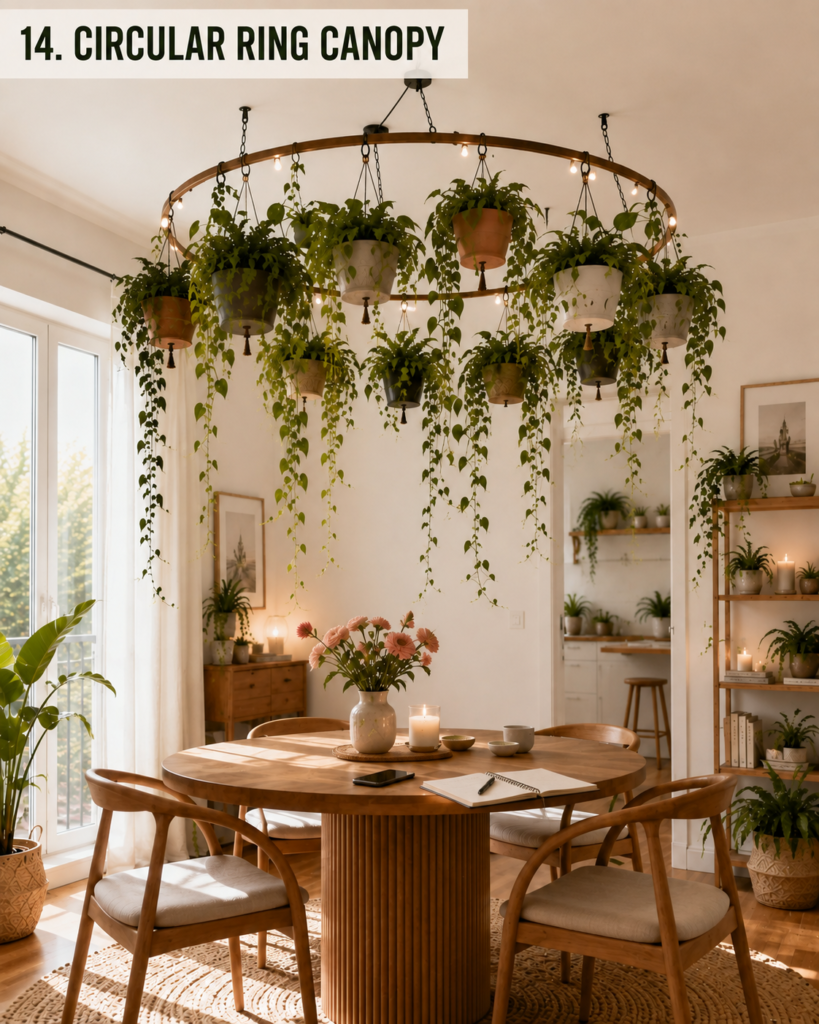
Use one or more circular overhead rings as the structural basis for a plant display.
Plants can be distributed around the ring, with foliage cascading toward the center and outer edges.
Using rings of different diameters can create a more dynamic composition while preserving a clear geometric structure.
Best for: focal points and statement installations.
15. Suspend Plants From a Natural Branch
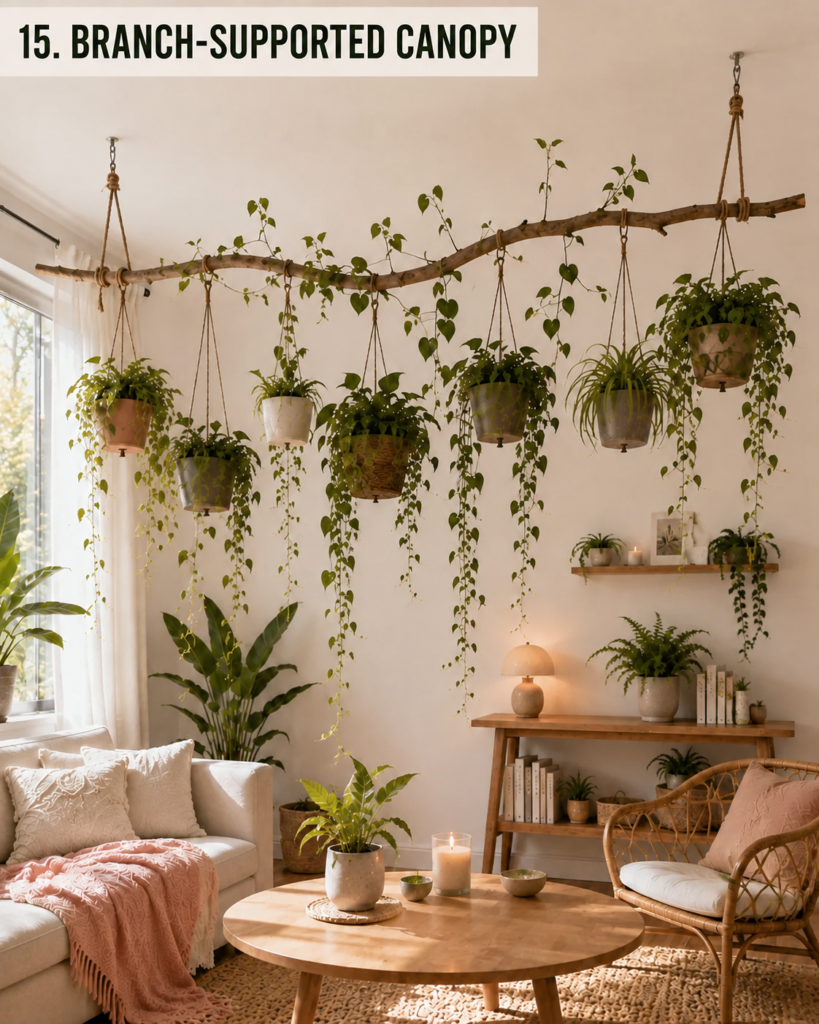
A natural branch can become the support element for a small hanging display.
Suspend several lightweight plants from the branch and position it above a seating or dining area.
The irregular geometry of the branch contrasts with more formal interior architecture and creates a deliberately organic appearance.
The branch and its mounting system must be structurally appropriate for the complete loaded weight.
Best for: organic, bohemian, and nature-inspired interiors.
16. Create a Partial Green Ceiling Panel
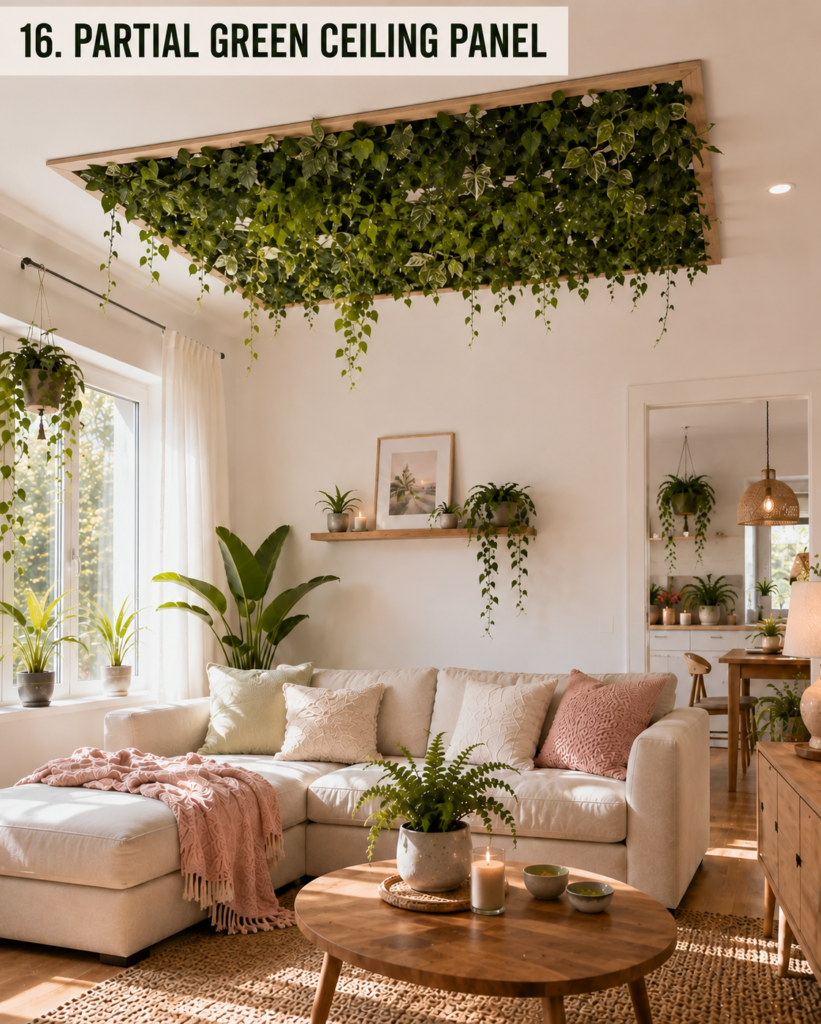
You don’t have to make the entire ceiling green.
Instead, create a concentrated rectangular or square section of greenery above one architectural zone.
The rest of the ceiling remains visible, which makes the green panel read as an intentional design feature rather than uncontrolled plant growth.
Best for: modern interiors where you want a strong focal point.
17. Mark an Entryway With a Plant Canopy
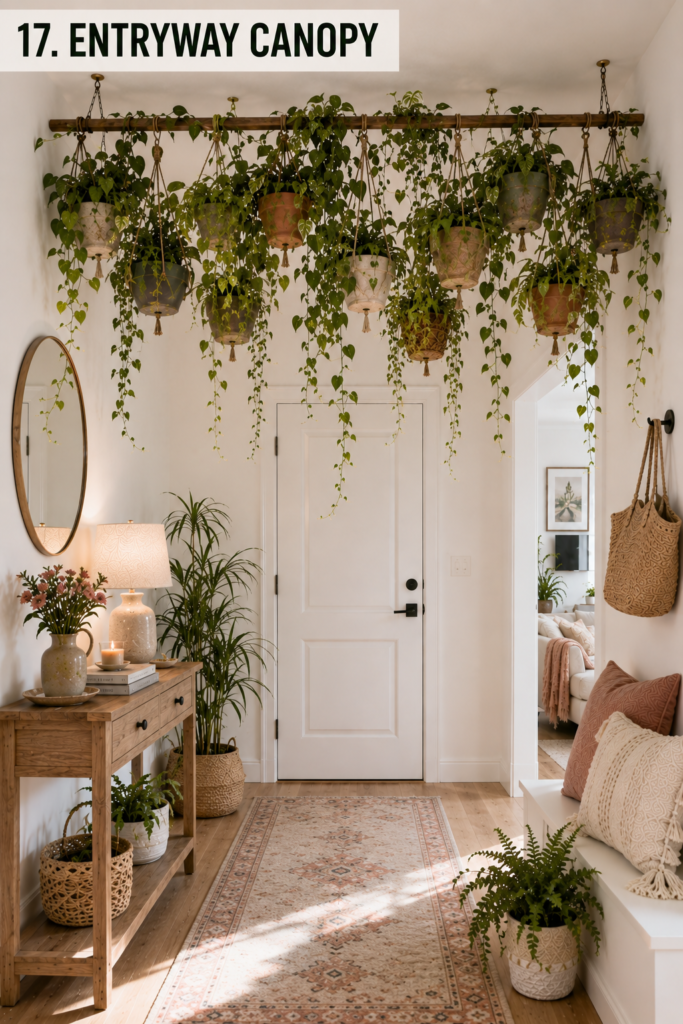
An entryway can benefit from a small overhead canopy that marks the transition into the home.
A few carefully positioned trailing plants can soften the upper portion of the entrance without taking up valuable floor space.
Keep the installation high enough to preserve a clear circulation path.
Best for: entrances, hallways, and transitional spaces.
18. Build a Canopy Around a Skylight
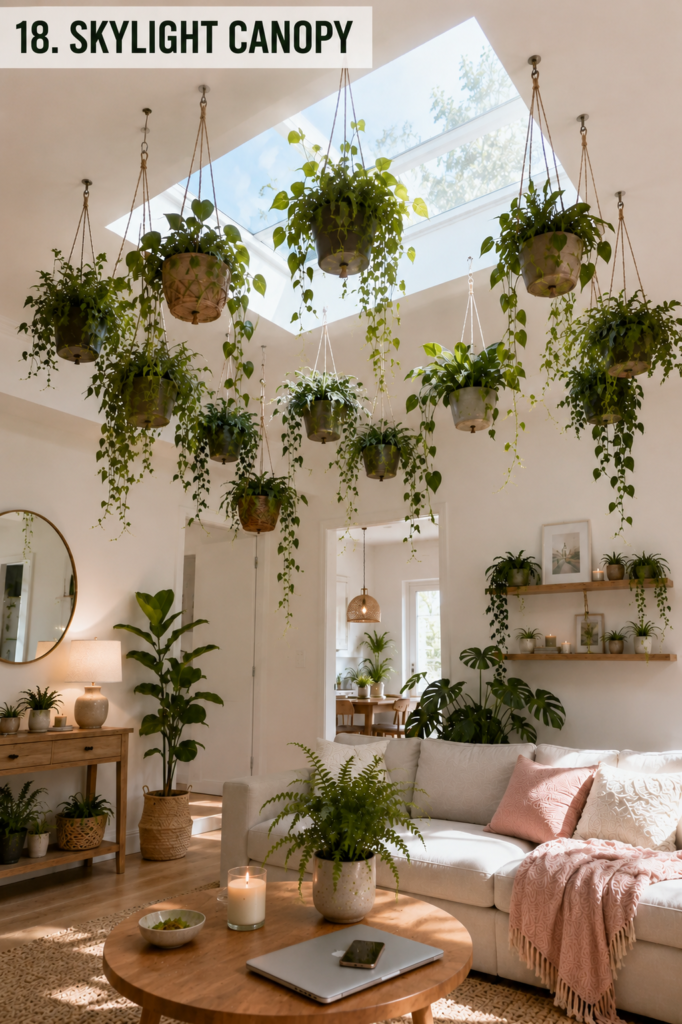
A skylight can provide an especially interesting opportunity because plants suspended nearby can receive significantly more natural light than those positioned deeper inside the room.
Arrange suitable plants around the light source and allow trailing foliage to frame the skylight.
However, plant selection must match the actual light intensity and temperature of the location rather than assuming that every plant will thrive there.
Best for: bright rooms and conservatories.
19. Build a Freestanding Canopy Frame
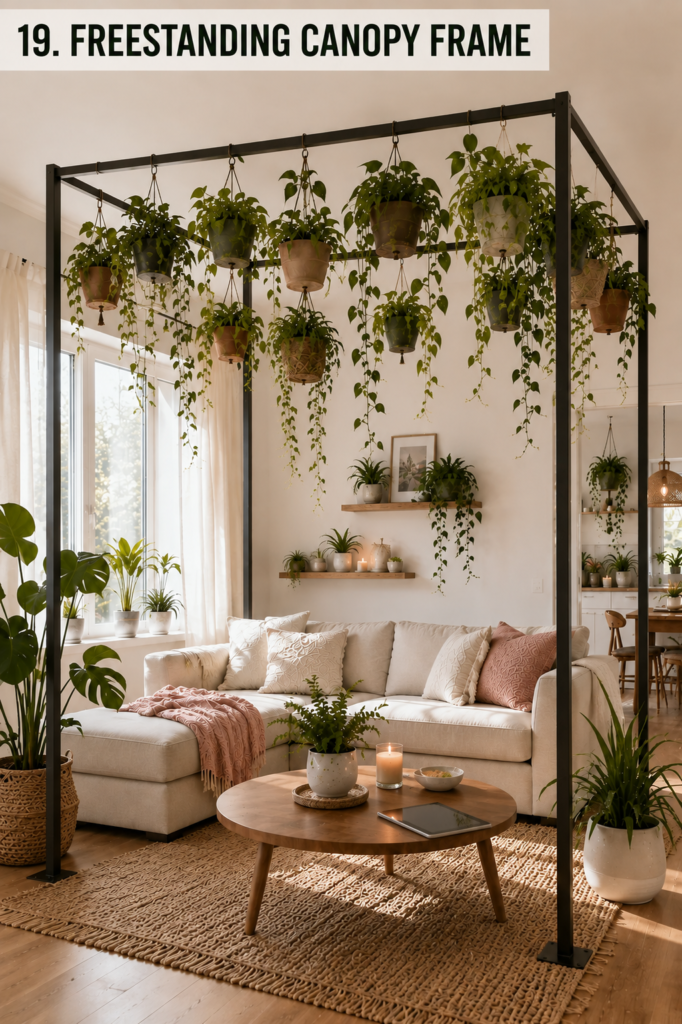
Instead of attaching the canopy directly to the ceiling, create an independent frame that supports the plants above a defined area.
This is one of the most architecturally distinctive approaches because the frame itself becomes part of the room.
The plants can then hang from the upper structure while the floor below remains open.
Best for: renters, flexible interiors, and highly intentional installations.
20. Create a Mini Canopy for Small Spaces
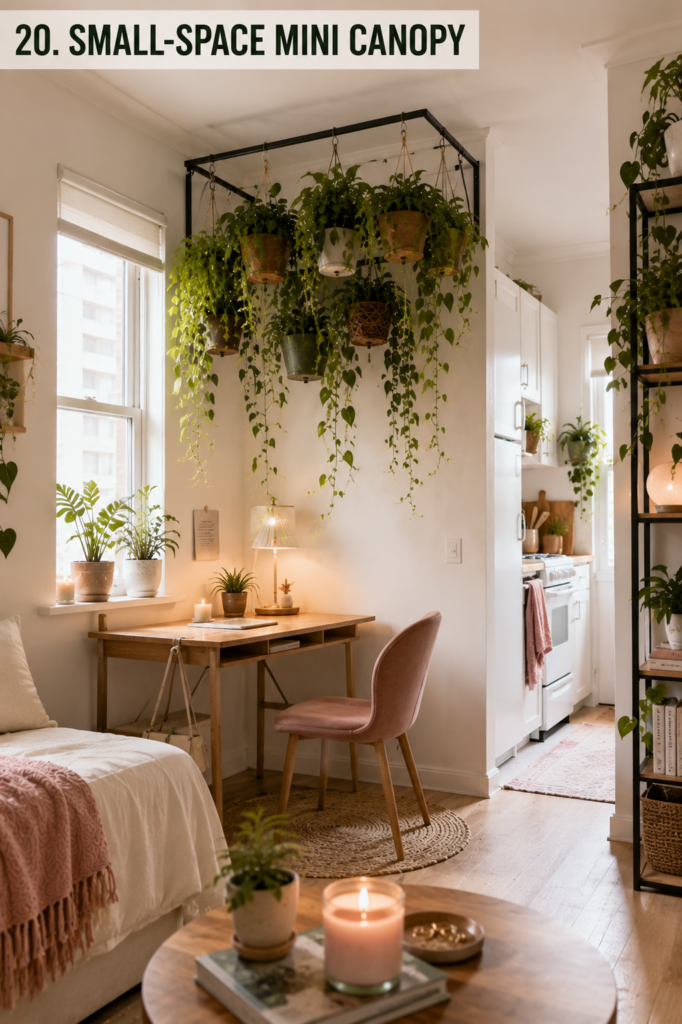
A canopy doesn’t have to be large to have an effect.
In a small apartment, create a compact overhead composition above a chair, desk, bed corner, or narrow dining area.
Use only a few plants and keep the structure proportional to the room.
The objective is not maximum density. It is to introduce a new layer of greenery without making the space feel crowded.
Best for: apartments, studios, and compact rooms.
Best Plants for an Indoor Canopy
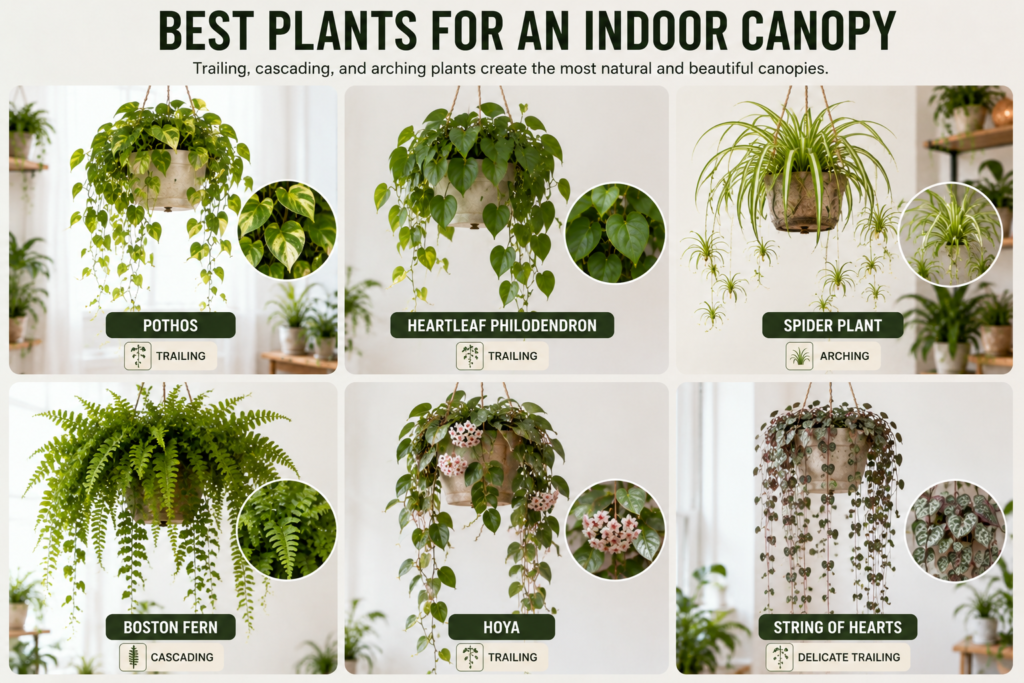
The best plants for an indoor canopy are generally those with a natural trailing, cascading, or arching growth habit.
Pothos
Pothos is particularly useful for canopy designs because its vines can trail downward and tolerate a range of indoor conditions.
Heartleaf Philodendron
Its trailing growth makes it useful for both individual hanging containers and larger canopy compositions.
Spider Plant
The arching foliage and offsets create movement without requiring extremely long vines.
Boston Fern
Boston fern can provide dense, textural foliage in a hanging container, although it requires more attention to moisture than some trailing plants.
Hoya
Hoya can work well when you want longer trailing stems without extremely dense foliage.
String of Hearts
Its fine trailing stems create a lighter, more delicate canopy effect.
The correct choice ultimately depends on the actual light and growing conditions of the location.
How to Plan an Indoor Plant Canopy
Before installing anything, determine four things.
1. Check the Available Light
Map the natural light in the room before deciding where individual plants will go.
Plants with greater light requirements should not simply be placed in the most visually convenient position.
2. Calculate the Full Supported Weight
Don’t calculate the load using the dry nursery pot alone. The relevant load includes the container, soil, plant, hanger, and water.
3. Plan How You Will Water the Plants
A beautiful canopy that requires standing on an unstable chair every week is not a good long-term solution.
Consider access before installation.
4. Set the Right Hanging Height
The canopy should create visual impact without becoming an obstacle.
The lowest foliage should remain comfortably outside normal circulation paths.
How to Hang Plants Safely
The exact installation method depends on the ceiling construction and the weight of the plant.
Common approaches include ceiling hooks, appropriate anchors, beams, rails, and other structural support systems.
For drywall or plasterboard, the appropriate anchoring method depends on the construction and load. For structural beams, hardware must still be matched to the material and expected load.
Never assume that a hook’s advertised capacity automatically applies to your particular ceiling.
And always account for the increased weight after watering.
How to Make a Plant Canopy Look Intentional
The difference between a canopy and a collection of hanging plants is composition.
Use:
- deliberate spacing;
- controlled variation in hanging height;
- repeated container styles when appropriate;
- different foliage textures;
- negative space;
- a clear relationship to the furniture below.
Avoid distributing plants randomly simply because there is an available place to hang another pot.
The strongest compositions make the overhead greenery feel like part of the room’s architecture.
Common Indoor Plant Canopy Mistakes
Making Every Plant the Same Height
Uniformity can make the installation look flat.
Making Everything Equally Dense
Leaving some negative space helps the canopy breathe.
Ignoring Maintenance
A plant that is difficult to reach will eventually become difficult to care for.
Choosing Plants Based Only on Appearance
Light and growing conditions matter.
Underestimating Wet Weight
Water can significantly increase the load of a hanging planter, so the fully watered installation needs to be considered when selecting hardware.
Letting Foliage Enter Circulation Paths
The canopy should frame the room rather than interfere with it.
Final Takeaway
You don’t need more floor space to add more plants.
Look up.
An empty ceiling can become another layer of your indoor garden—whether that means a few plants above a reading chair, a structured canopy over a dining table, or an entire overhead jungle.
The most successful approach is to choose the structure first, then select plants and spacing that work with it.
That turns hanging plants from isolated decorations into a genuine indoor plant canopy.